Morse Code Translator
Convert text to Morse and Morse to text instantly with audio, light, WPM speed, WAV export and a quick reference table.
Morse Code Translator
Incredible Features of our Morse Code Translator
Our Morse Code Translator includes many useful features. Below we explain each of them.
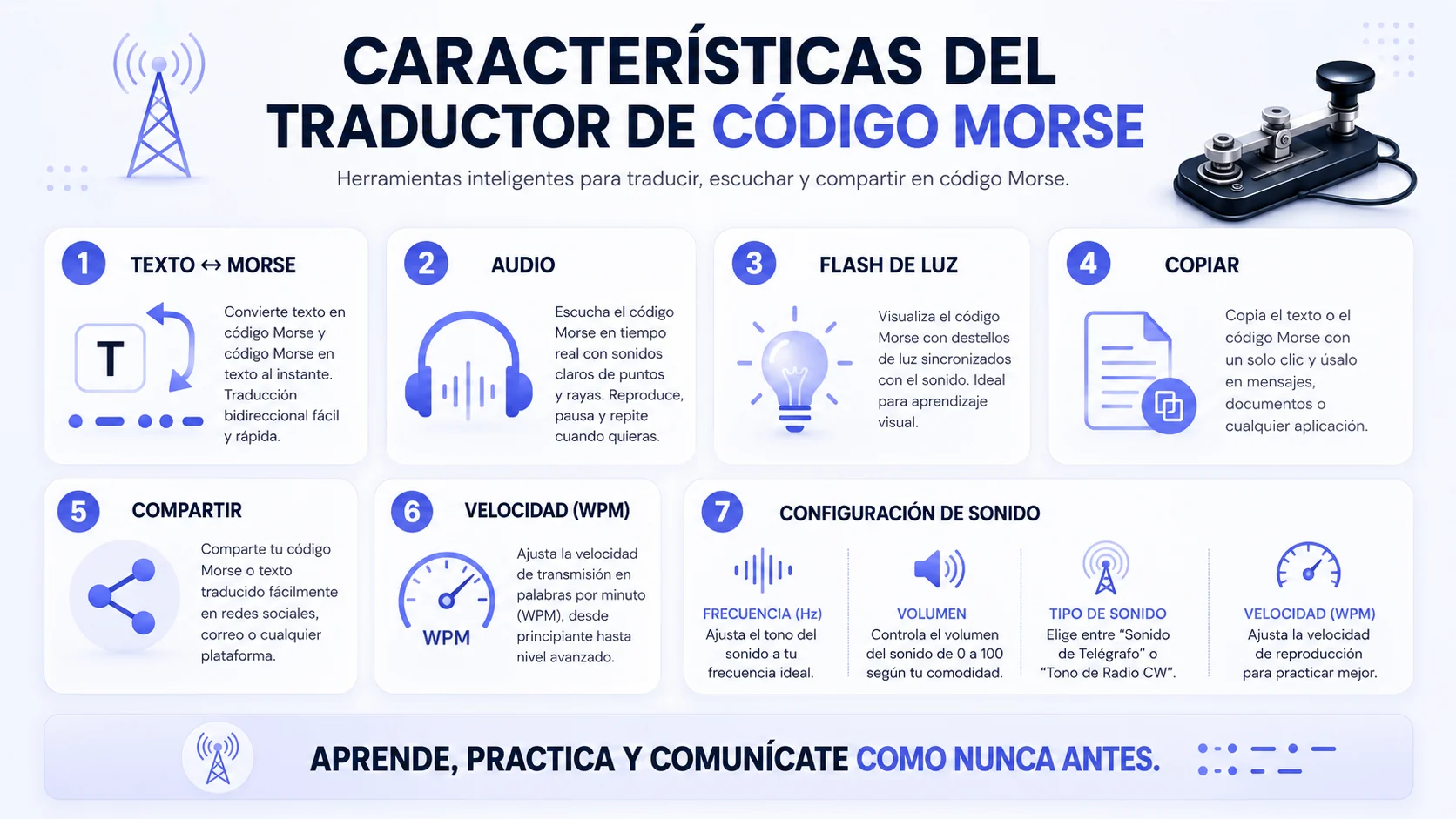
Convert text to Morse Code
Type or paste your message in the text box. The translator will automatically convert your text into Morse Code using dots (.) and dashes (-).
Translate Morse Code to text
It can also translate Morse Code to plain text. Enter the code and the translator will decode it instantly.
Accurate real-time translation
Our modern algorithm instantly converts Morse to text and vice versa, ensuring accurate results as you type.
Generate random messages
Click the random button to create random texts and Morse Code examples. Helps learn new patterns and improve reading speed.
Interactive audio with WPM control
Press the play button to hear the message. Adjust speed, frequency and volume. You can pause and repeat it as many times as you want.
Copy and share
With one click you can copy the content to the clipboard. The Share button allows you to send the result directly to other people.
Visual light signal (Flash)
The Morse output is shown through light flashes synchronized with the sound. Dot = short flash. Dash = long flash.
Advanced settings
Adjust frequency Hz, volume, WPM speed, Farnsworth WPM and sound type (telegraph or CW radio) according to your needs.
Real-time counters
Character and signal counters below each text box to control message length and the number of signals transmitted.
Need to decode another format? Use the Morse Code Audio Translator for beeps and recordings, or the Morse Code Image Translator for screenshots and scanned signals.
What is Morse Code?
Morse Code is a universal telecommunication language that uses a combination of dots and dashes, also known as dits and dahs. It was invented by Samuel Morse and Alfred Vail. Although it has largely been replaced by digital technologies such as Wi-Fi and mobile phones, it is still used in various industries.
International Morse Code (ITU) encodes the Indo-Arabic numerals (0–9), one accented Latin letter (É), the 26 basic letters of the Latin alphabet (A–Z), and some punctuation marks.
Each letter has its own unique rhythm, making communication easy. It can be easily memorized because it transmits signals through visible light, sound waves or electrical impulses.
To improve the efficiency of message transmission, Vail designed the original alphabet by reducing the frequency of the most common characters in English. For example, the letter E (the most used in English) is represented by a short dot (.), while T is represented by a long dash (-).
Morse Code is simple and easy to understand. With just two symbols, it allows you to transmit virtually any imaginable message. Our contact page is available if you have questions or want to share your experience with the tool.
Curious facts about Morse Code
Morse Code can be spoken
Samuel Morse sent the first message nearly 180 years ago
The @ symbol was added in 2004 for email addresses
The first message was: "What hath God wrought!"
Titanic staff used Morse Code to communicate
Samuel Morse was a painter before becoming an inventor
SOS was specially created for emergencies
It can be used over long distances
Can also be communicated through eye blinks
Korean and Japanese versions of Morse exist
NASA uses this language in space missions
Made communication much faster in the 19th century
Morse Code Alphabet
Memorize the Morse alphabet to communicate with dots and dashes. The infographic and table below show each letter with its Morse equivalent.
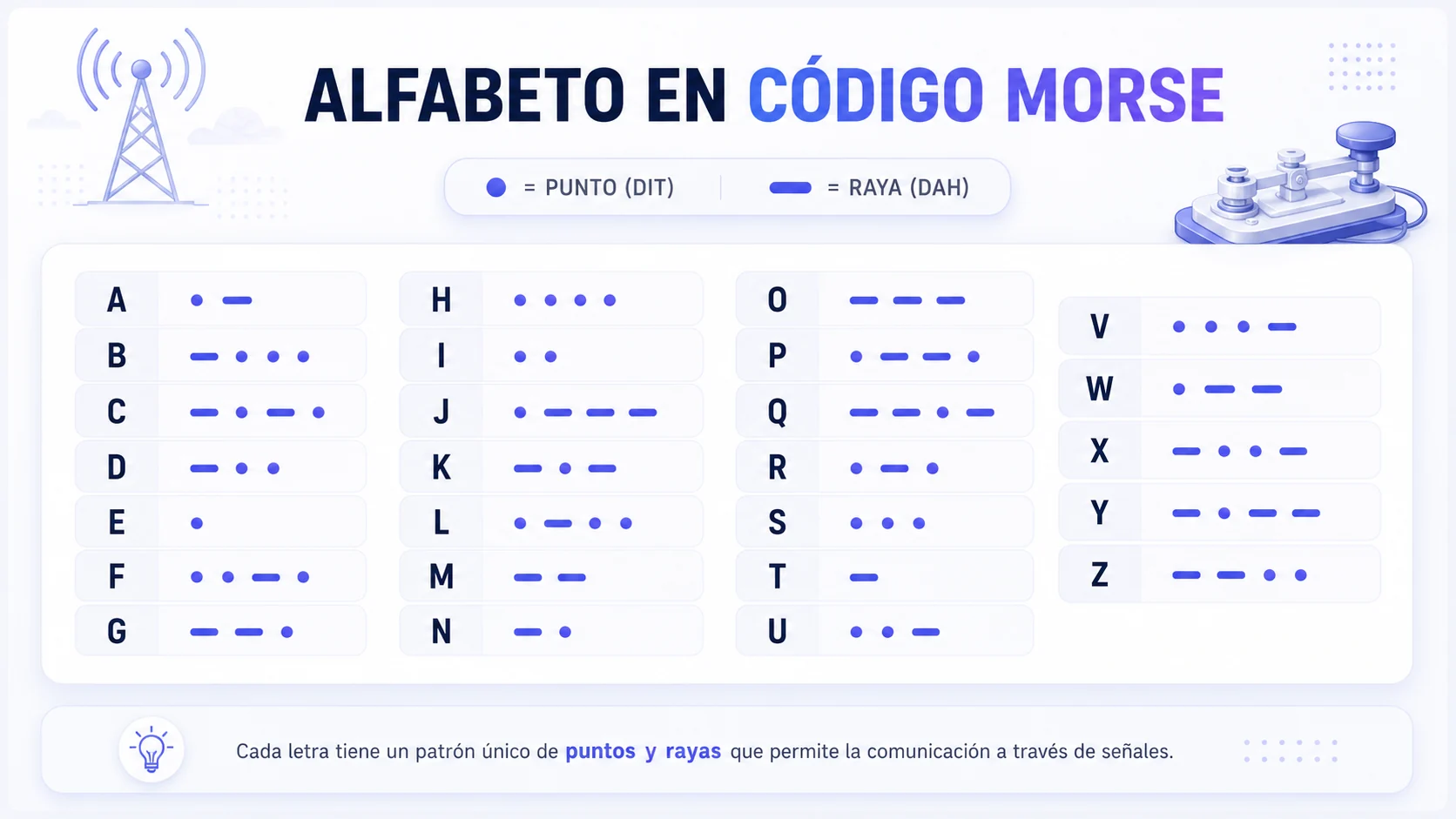
Start with individual letter guides such as A in Morse Code, B in Morse Code, and C in Morse Code to build rhythm step by step.
Numbers in Morse Code (0–9)
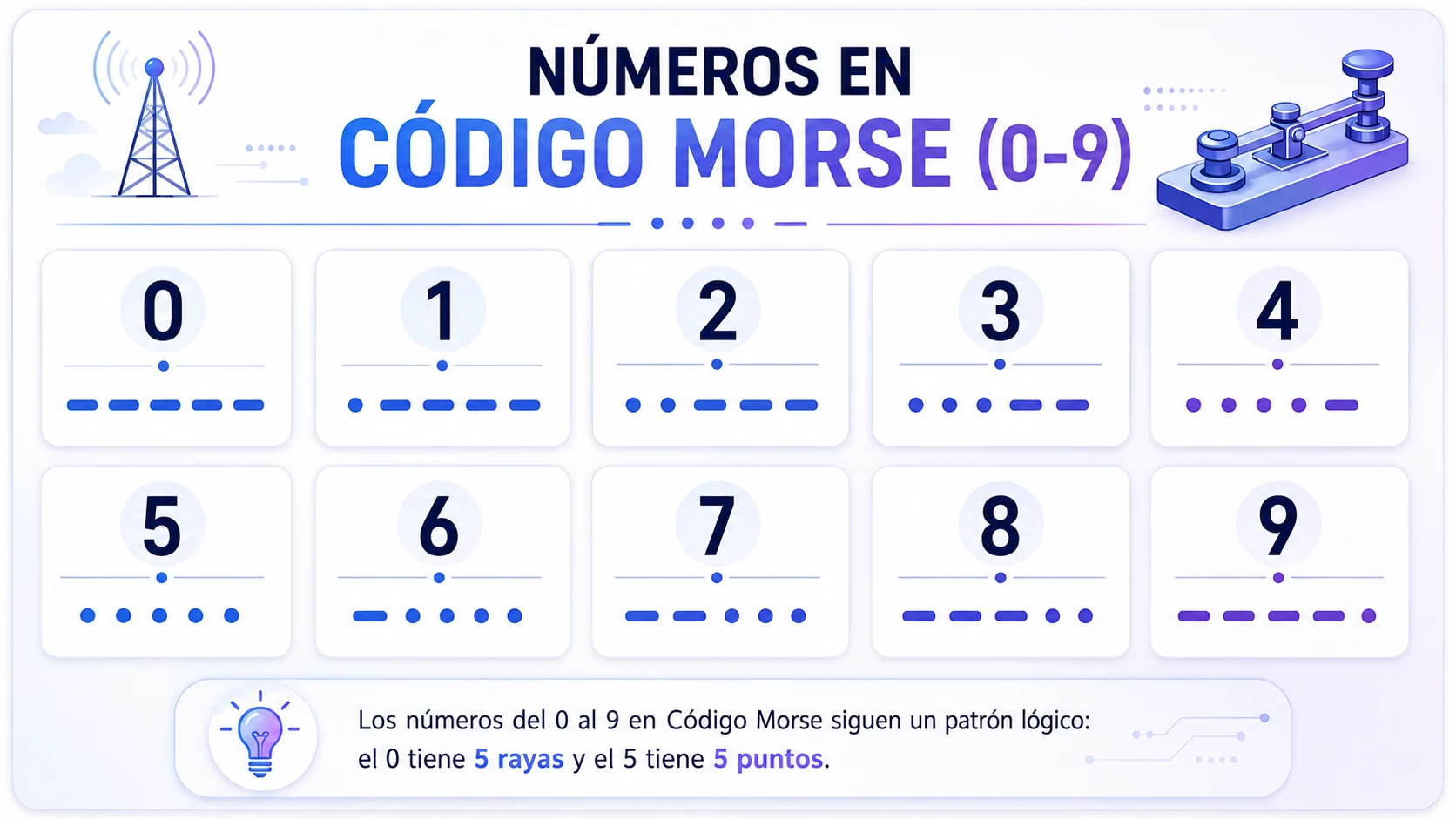
Numbers in Morse Code always consist of five symbols. Each digit has an easy-to-remember pattern.
Symbols and Punctuation in Morse Code
Morse Code also includes the most commonly used punctuation marks and special prosigns to indicate the start and end of transmissions.
| Symbol | Morse Code | Symbol | Morse Code |
|---|---|---|---|
| Period (.) | . - . - . - | Parenthesis ( | - . - - . |
| Comma (,) | - - . . - - | Parenthesis ) | - . - - . - |
| Question mark (?) | . . - - . . | Equals sign (=) | - . . . - |
| Slash (/) | - . . - . | Quotation marks (") | . - . . - . |
| Hyphen (-) | - . . . . - | At sign (@) | . - - . - . |
Morse Code Prosigns
| Prosign | Morse Code |
|---|---|
| End of Work (SK) | . . . - . - |
| Error (HH) | . . . . . . . . |
| Wait (AS) | . - . . . |
Traditional uses of Morse Code
In the 19th and 20th centuries, Morse Code was essential for maritime and telegraphic communication. SOS (... --- ...) became a universal distress signal. Telegraph operators used it to transmit messages quickly and efficiently over long distances. It was also a valuable tool in military operations during the world wars, where voice communications were dangerous or impractical.
Benefits of using our translator
Easy to use and accessible
Available online and works on mobile, tablets and computers without installation. Visit our contact page for support.
Fast conversion
Instant real-time results with no delays.
Free and safe
All features are completely free. Private and secure. Learn more on our about us page.
User-friendly interface
Simple and easy-to-understand design for any user.
Visual and audio results
The combination of audio and visual signals helps learn the rhythm of Morse Code.
Educational and fun
Complete learning experience for students, hobbyists and families.
Frequently Asked Questions
Generally, most people take between one and two months of regular practice of 15 to 30 minutes a day. To reach a good speed level (between 15 and 20 words per minute), it usually takes two to three months of intensive daily sessions.
Yes, the tool includes audio playback. You can adjust the WPM speed, frequency in Hz, volume and sound type. You also have the Flash visual signal synchronized with the audio.
Yes, it works perfectly on all devices: mobile, tablet and computer. The design is fully responsive and mobile-first.
Yes, it supports letters, numbers and symbols.
No, we do not save user data. All conversion happens directly in your browser. See our privacy policy for more information.
SOS is written as: ... --- ... (three dots, three dashes, three dots). It is the most recognized international distress signal in the world.
I = .. / L = .-.. / O = --- / V = ...- / E = . / Y = -.-- / O = --- / U = ..-
About the Author