Morse code can seem difficult to memorize at first, but YES can be learned by practicing the three letter patterns Y, E, and S. The word can be used as a short, clear affirmative answer to a question.
By understanding how to send and receive this word, you can communicate it accurately and respond quickly.
YES in Morse code can be used to give an affirmative response or confirmation.
In this guide, we’ll explain YES in Morse code, how to send it using different signals, how to learn it, and where Morse code is used.
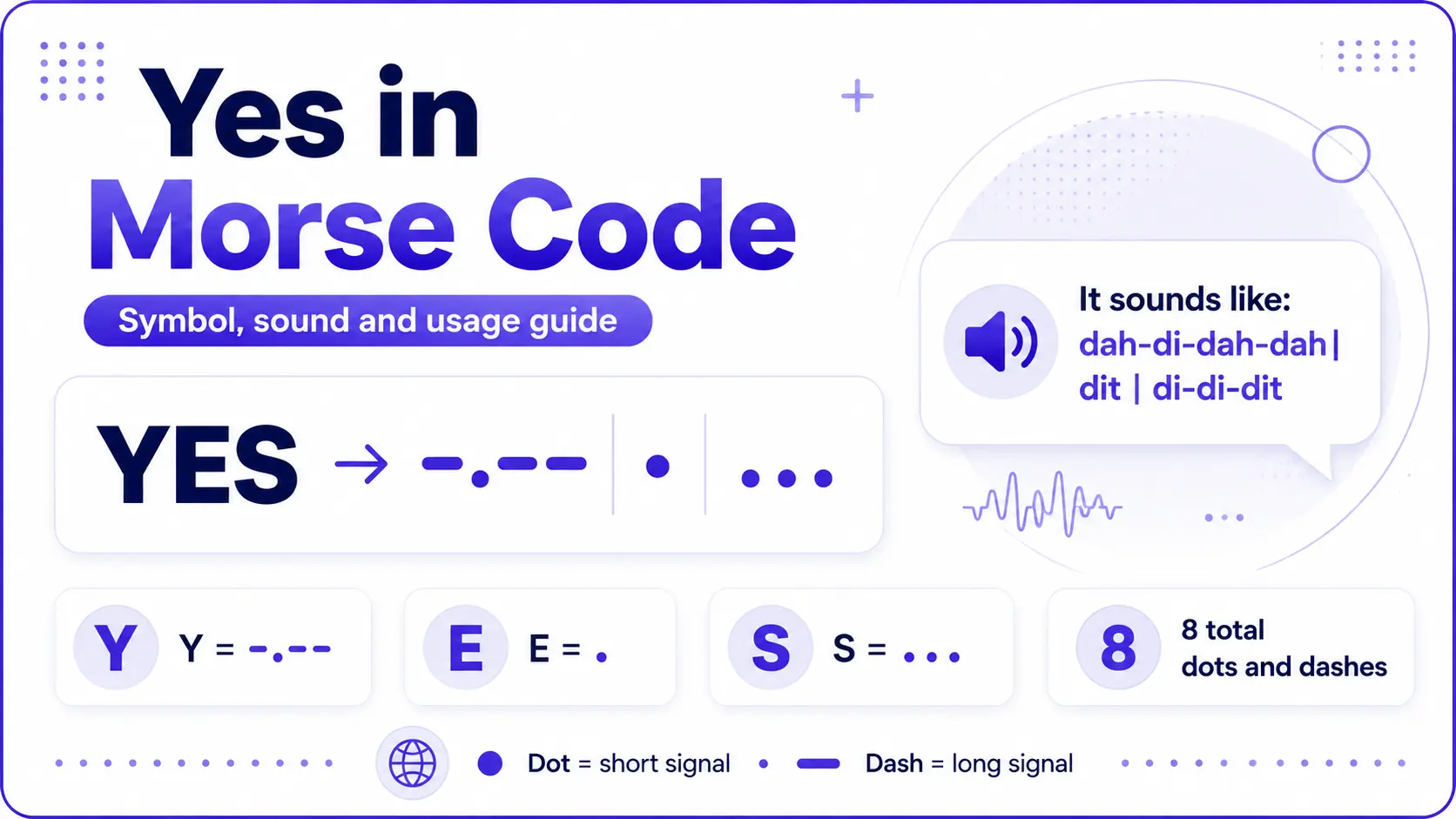
What Is Yes in Morse Code?
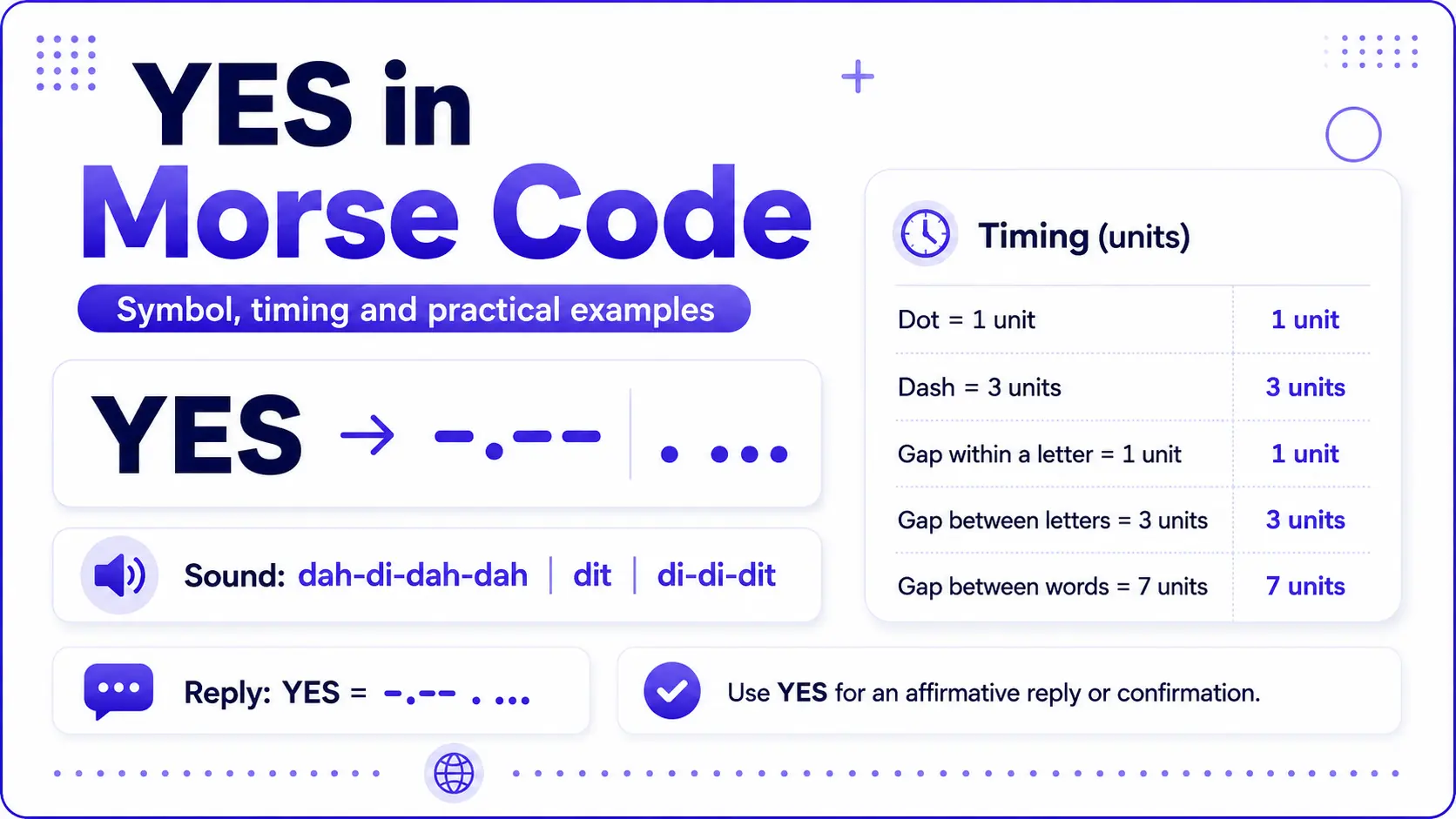
YES in Morse code is written as -.-- . ...; it is transmitted as three letters: Y, E, and S, and consists of eight dots and dashes. Y is dash-dot-dash-dash, E is a single dot, and S is three dots in a row. These dots and dashes are transmitted with standard spacing rules.
| Letter | Morse Code | Dots and Dashes | Spoken Sound | Signals |
|---|---|---|---|---|
| Y | -.-- | dash dot dash dash | dah-di-dah-dah | 4 signals |
| E | . | dot | dit | 1 signal |
| S | ... | dot dot dot | di-di-dit | 3 signals |
| Total | 8 signals |
Visual representation of Morse Code YES = -.-- . ...
When spoken together: dah-di-dah-dah | dit | di-di-dit
Remember that when sending the word YES, pauses between letters are essential for accurate decoding.
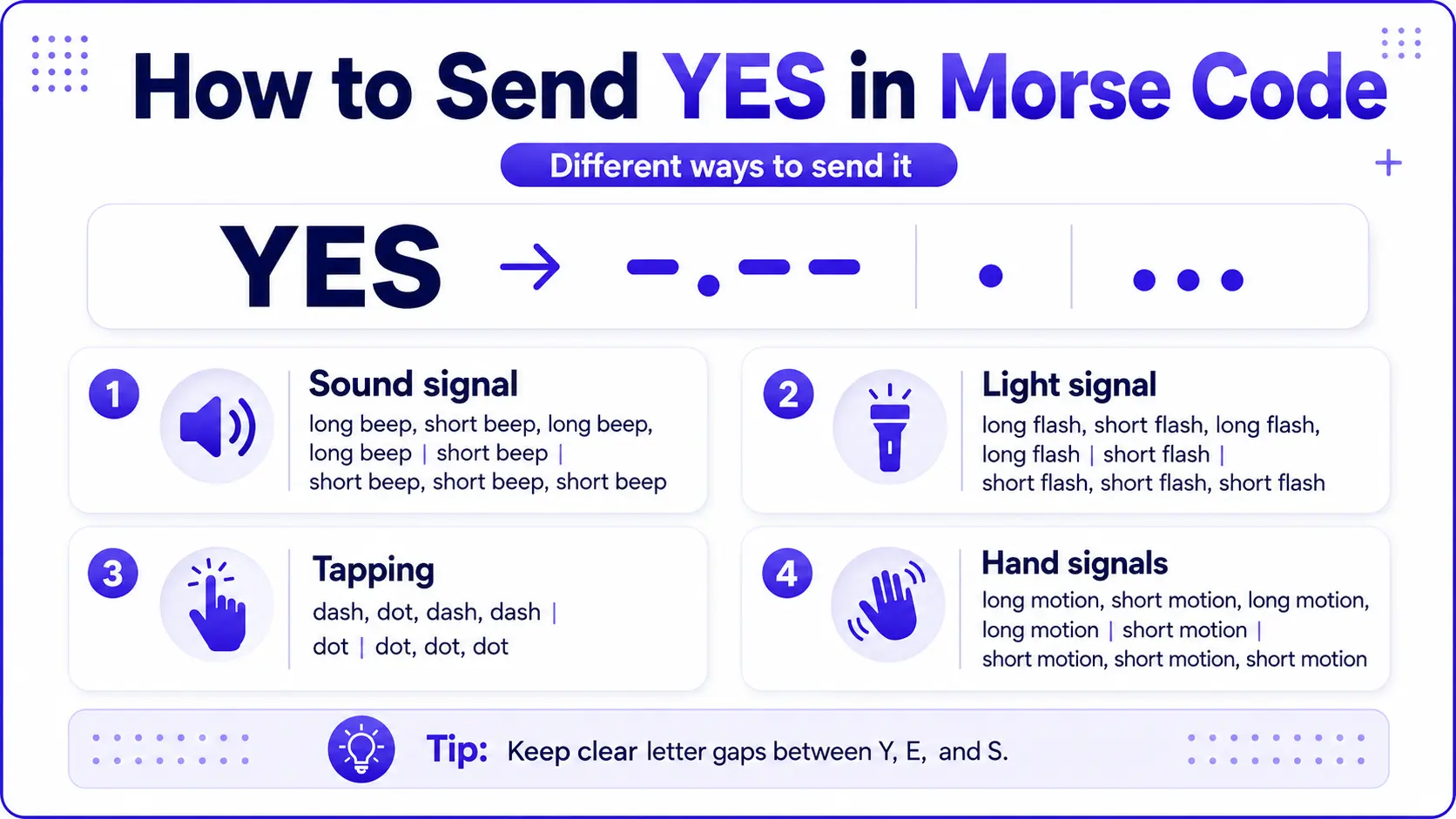
Different Ways to Send Yes in Morse Code
YES in Morse code can be represented using short and long signals through light, tapping, or sound. Agreed visual movements can also be used informally if both people understand how dots and dashes are represented.
Flashlight
Use a phone flashlight or a torch, switching it on and off for short and long durations:
- Flash Y: long → short → long → long
- Flash E: short
- Flash S: short → short → short
Use the standard letter gap between Y and E and between E and S.
Tapping
Tap on a table with a pencil or knock on a wall or wooden surface. Use an agreed method that clearly distinguishes dots from dashes:
- Tap Y: dash → dot → dash → dash
- Tap E: dot
- Tap S: dot → dot → dot
Sound
Use a phone app, whistle, or buzzer to create sound:
- Beep Y = dah-di-dah-dah
- Beep E = dit
- Beep S = di-di-dit
What Is Yes in International Morse Code?
International Morse Code is standardized for international use. The pattern for YES is -.-- . ... wherever International Morse Code is used.
Moreover, letters such as A, B, and C use the same standardized dots and dashes in countries that use International Morse Code.
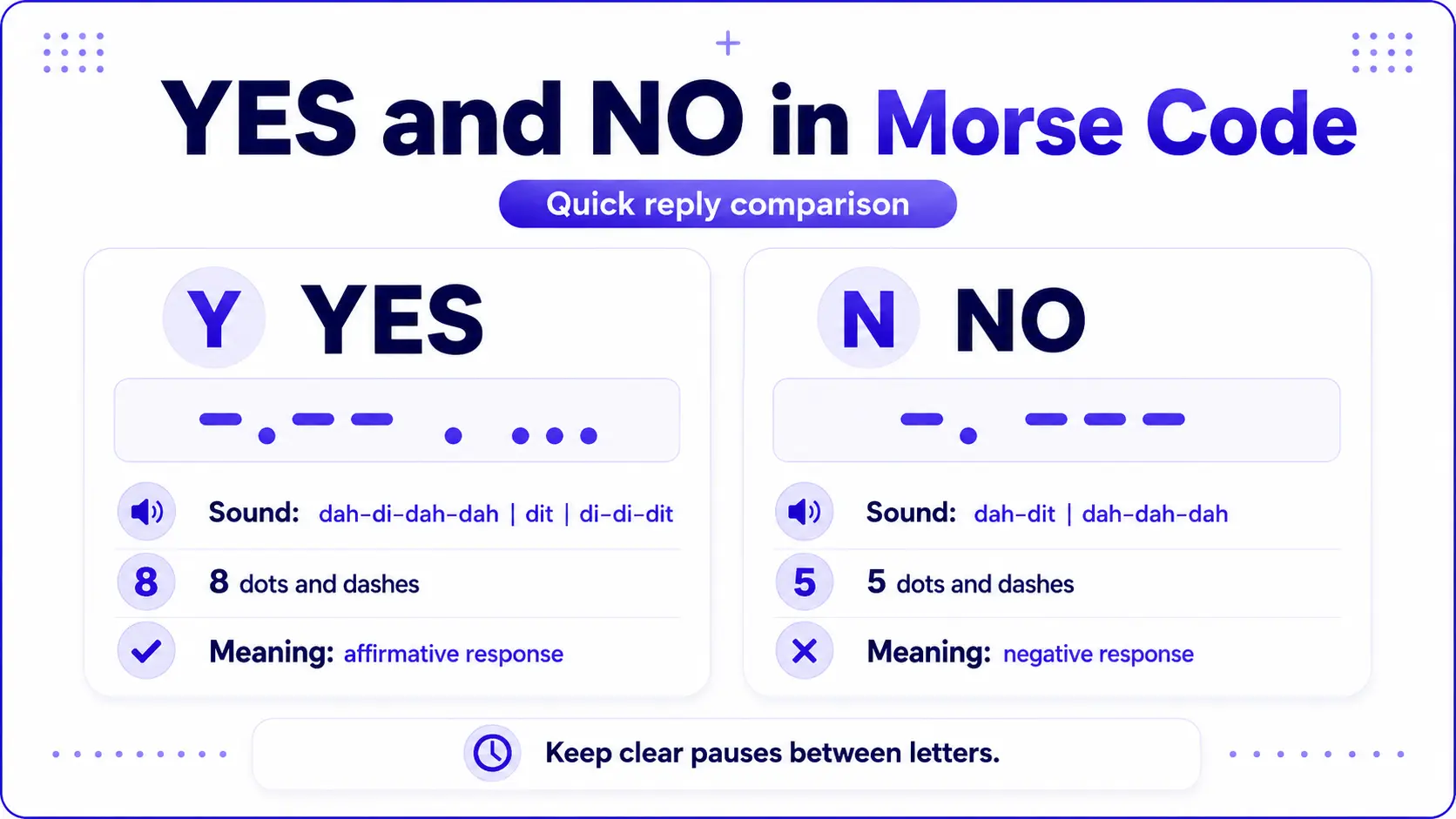
Yes and No in Morse Code for Quick Replies
Learning the words NO and YES gives you a way to answer simple questions when spoken communication is not possible and both people understand Morse code. These words are short but opposite in meaning. YES indicates agreement or confirmation, while NO gives a negative response or denial.
YES and NO can be transmitted in Morse code because each uses its own letter patterns:
To transmit YES and NO by sound, use:
- YES = dah-di-dah-dah dit di-di-dit
- NO = dah-dit dah-dah-dah
Morse code has historically been used in radio communication by military and amateur radio operators.
Where Is Morse Code Used?
Some people learn Morse code as a hobby, and there are various situations where Morse code, including simple patterns such as YES, can be useful.
- Amateur radio communication.
- Some emergency and disaster communication situations.
- Identification of certain aviation and navigation aids.
- Educational activities and classroom exercises.
- Using Morse code in artwork, design, and jewelry.
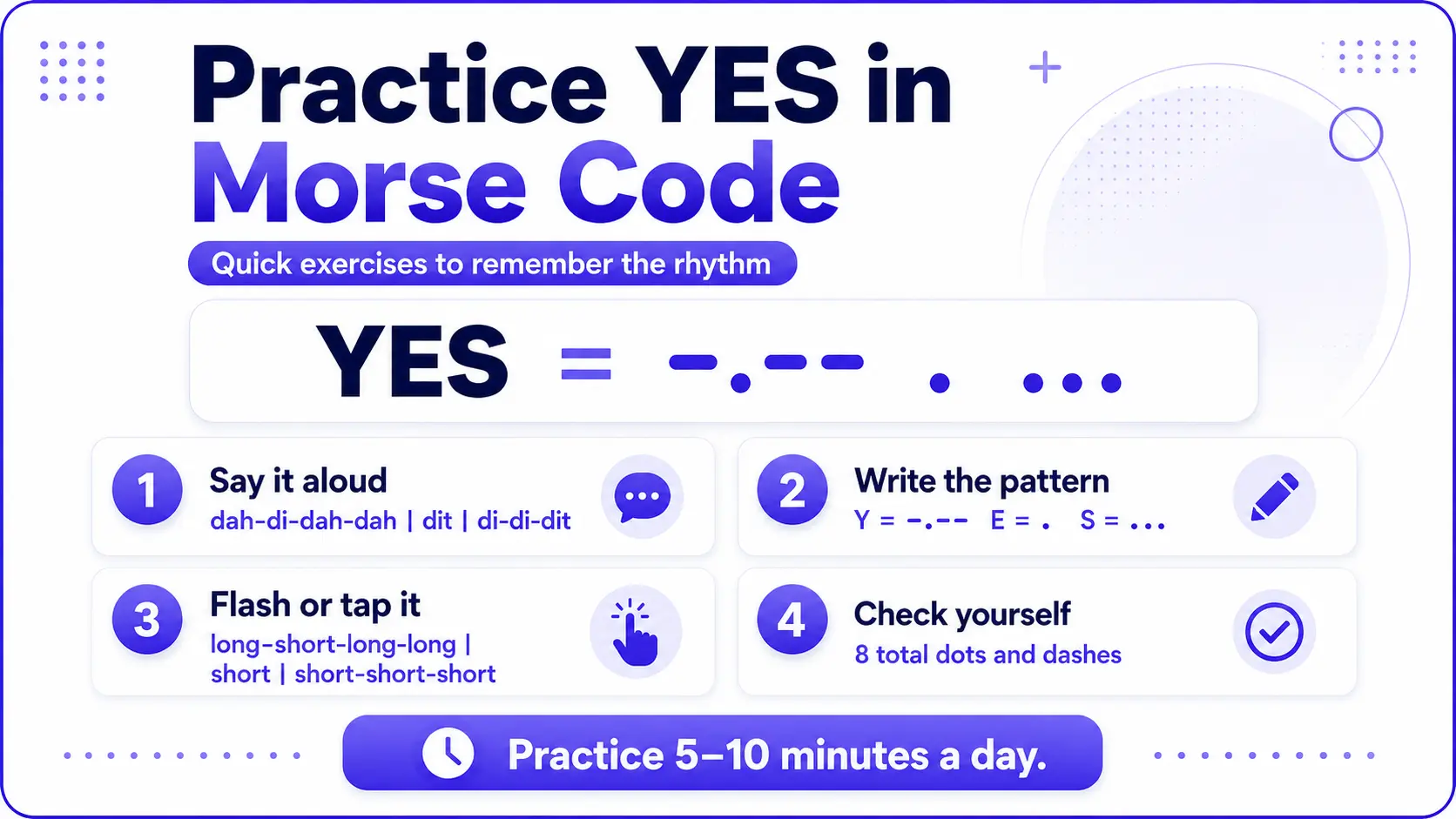
How Can Beginners Learn Yes in Morse Code?
Beginners can learn YES in Morse code by practicing its three letter patterns.
You can use the following practice methods:
- Focus on the sound, not just the symbol.
- Compare YES with other words such as NO.
- Practice regularly by sending and receiving letters.
- Memorize the correct pattern of dots and dashes for each letter.
- Test yourself by sending the message without looking at the pattern.
- Listen to Morse code at a slow speed and gradually increase your speed.
How Does Timing Work for Yes in Morse Code?
| Signal | Type | Duration |
|---|---|---|
| – | Dash (Y) | 3 units |
| Intra-character pause | 1 unit | |
| · | Dot (Y) | 1 unit |
| Intra-character pause | 1 unit | |
| – | Dash (Y) | 3 units |
| Intra-character pause | 1 unit | |
| – | Dash (Y) | 3 units |
| Letter gap | 3 units | |
| · | Dot (E) | 1 unit |
| Letter gap | 3 units | |
| · | Dot (S) | 1 unit |
| Intra-character pause | 1 unit | |
| · | Dot (S) | 1 unit |
| Intra-character pause | 1 unit | |
| · | Dot (S) | 1 unit |
A standard gap between words is 7 units.
YES vs. Other Common Morse Code Terms
| Term | Morse Code | Total Dots and Dashes |
|---|---|---|
| YES | -.-- . ... | 8 |
| NO | -. --- | 5 |
| OK | --- -.- | 6 |
| SOS | ...---... | 9 |
| HI | .... .. | 6 |