Learn the SOS Morse code pattern (··· --- ···), its meaning, history, and how to send SOS using sound, light, tapping, writing, radio, and digital signals.
SOS is part of modern International Morse code. Learn more about International Morse code.
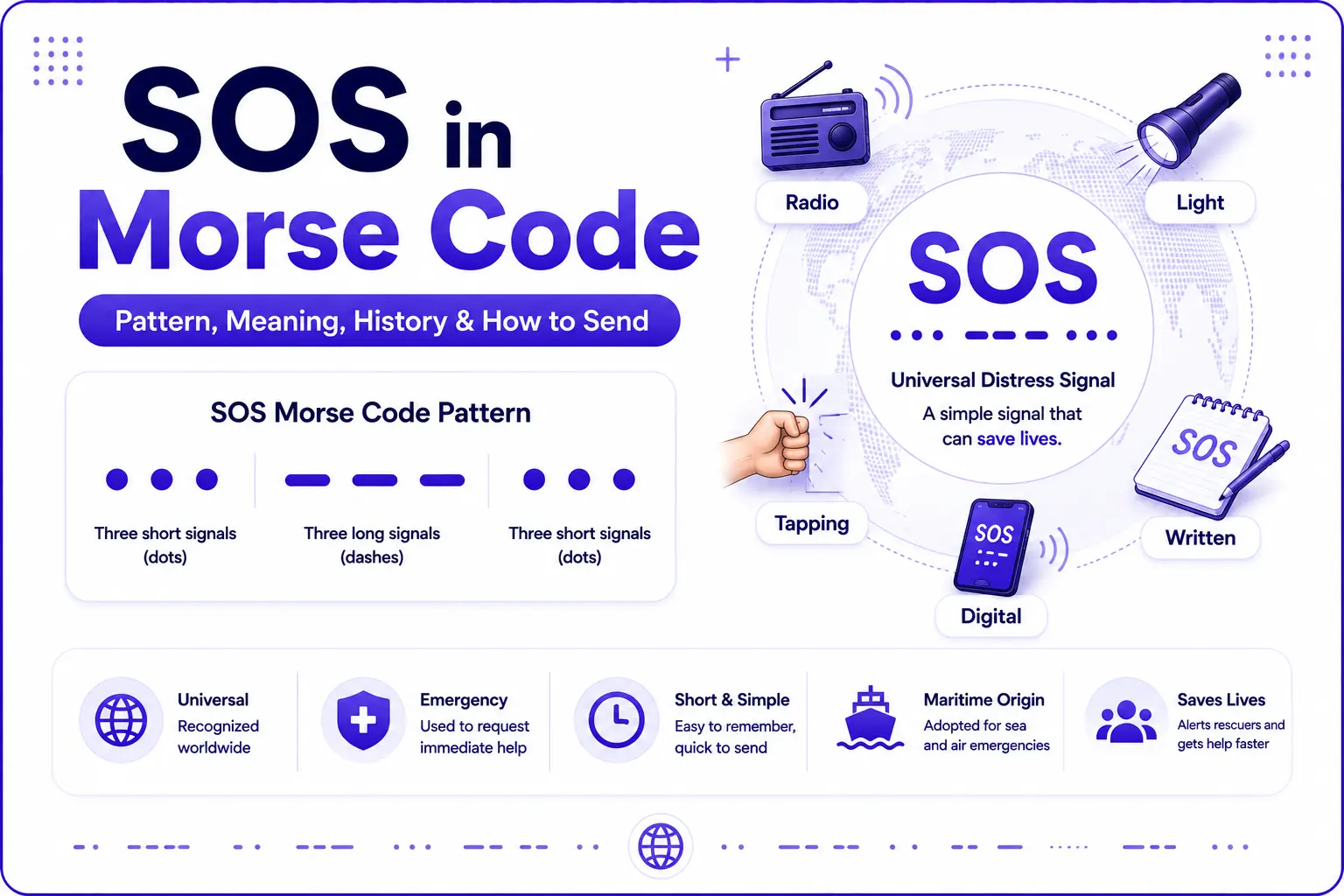
The SOS Pattern in Morse Code
SOS in Morse code is a simple and highly recognizable signal to recall in emergency situations and is known as an international distress signal. It has nine signal elements containing dots (short signals) and dashes (long signals). The letters SOS are sent as a continuous sequence without normal spacing between letters and consist of the following pattern:
- Three short signals
- Three long signals
- Three short signals again
Visual representation: ··· --- ···
History of the Distress Signal SOS
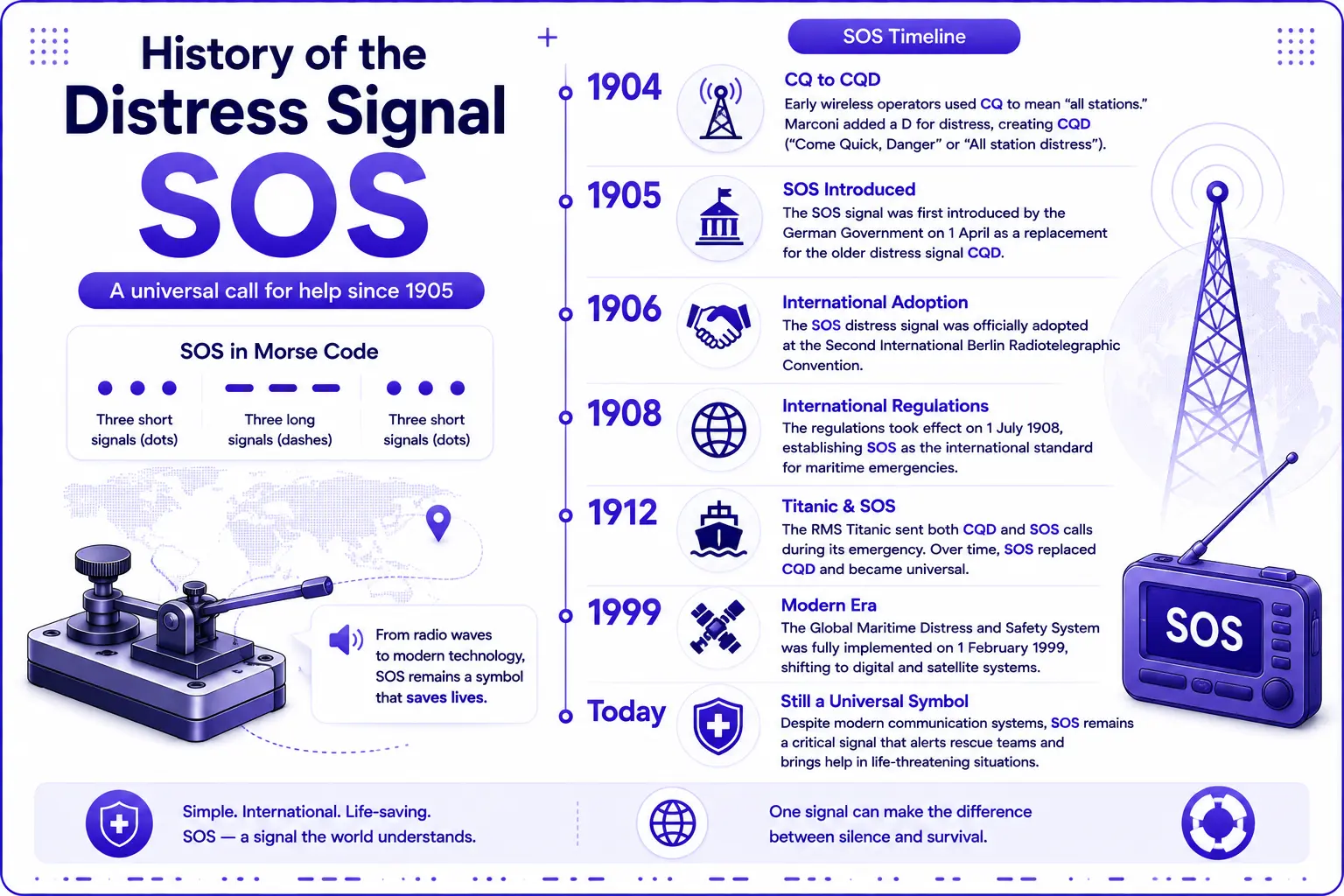
The SOS signal is a universal signal that was first introduced by German national radio regulations in 1905 and adopted internationally in 1906, with the regulation taking effect in 1908.
SOS Timeline
1904 - Early wireless operators used CQ as an emergency signal to mean “all stations.” In 1904, the Marconi company added a D for distress, creating CQD, which has often been interpreted as “Come Quick, Danger” or “All station distress.”
1905 - The SOS signal was first introduced by the German Government on 1 April as a replacement for the older distress signal CQD.
1906 - The SOS distress signal was officially adopted at the second International Berlin Radiotelegraphic Convention.
1908 - The international regulations took effect on 1 July 1908, establishing SOS as an international standard primarily associated with maritime emergencies.
1912 - The RMS Titanic sent both CQD and SOS distress calls for help during its emergency communications. Over time, SOS replaced CQD and became a universal symbol of emergency.
1999 - The Global Maritime Distress and Safety System was fully implemented on 1 February 1999, shifting maritime distress toward satellite and digital systems rather than manual Morse radiotelegraphy.
Today - Despite electronic distress beacons and modern communication systems such as phones, SOS remains a universal symbol of emergency. It continues to be associated with calls for assistance in dangerous situations, including sinking vessels and downed aircraft.
What Does SOS Stand For (And Why It Actually Doesn’t)?
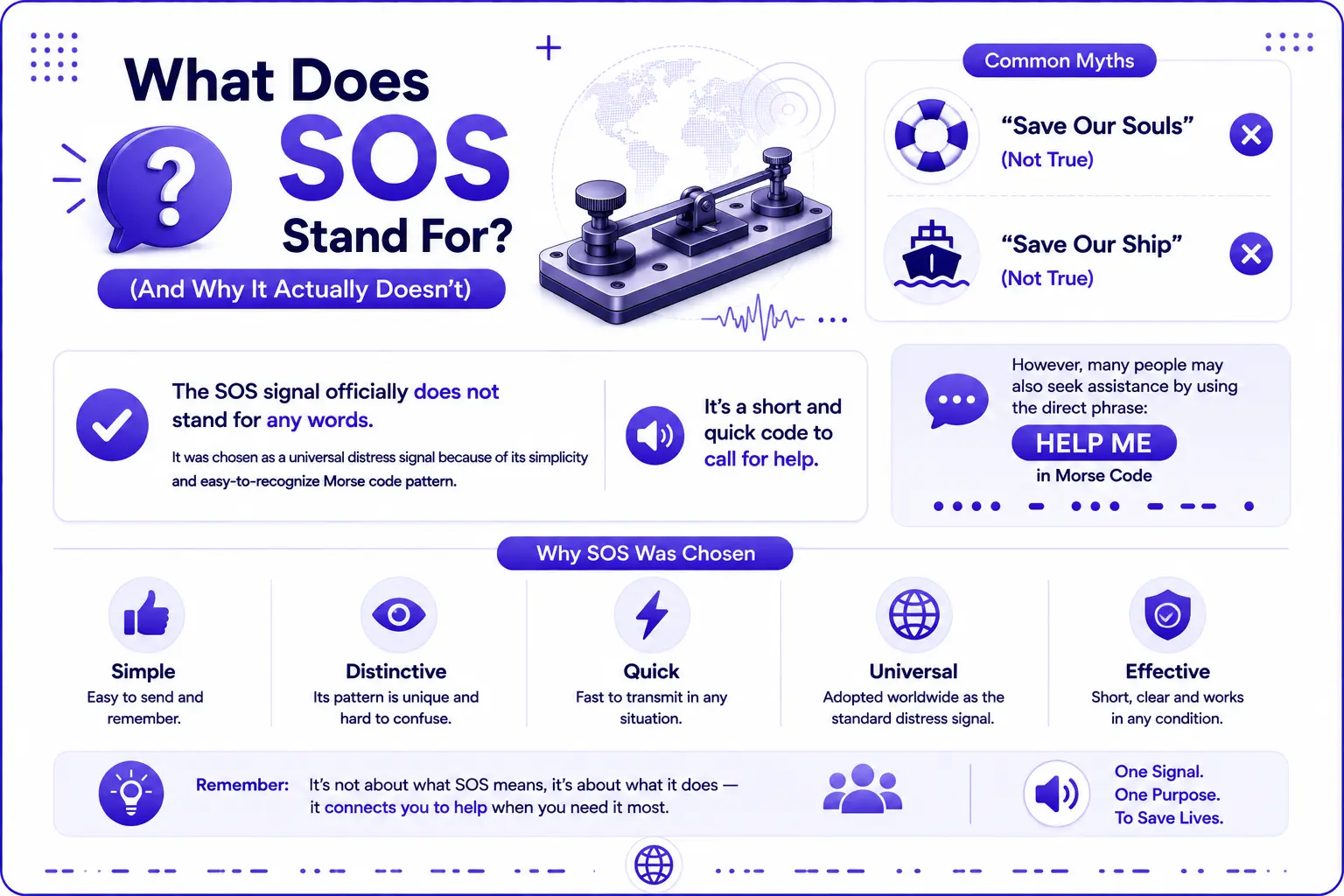
The common claims that the SOS signal stands for “Save Our Souls” and “Save Our Ship” are backronyms and misconceptions. In fact, the signal officially does not stand for any words. It was chosen as a universal distress signal because of its simplicity and easy-to-recognize Morse code pattern. It is a short and quick code to call for help.
However, people may also ask for assistance by spelling the direct word HELP in Morse code.
Different Ways to Send an SOS Signal
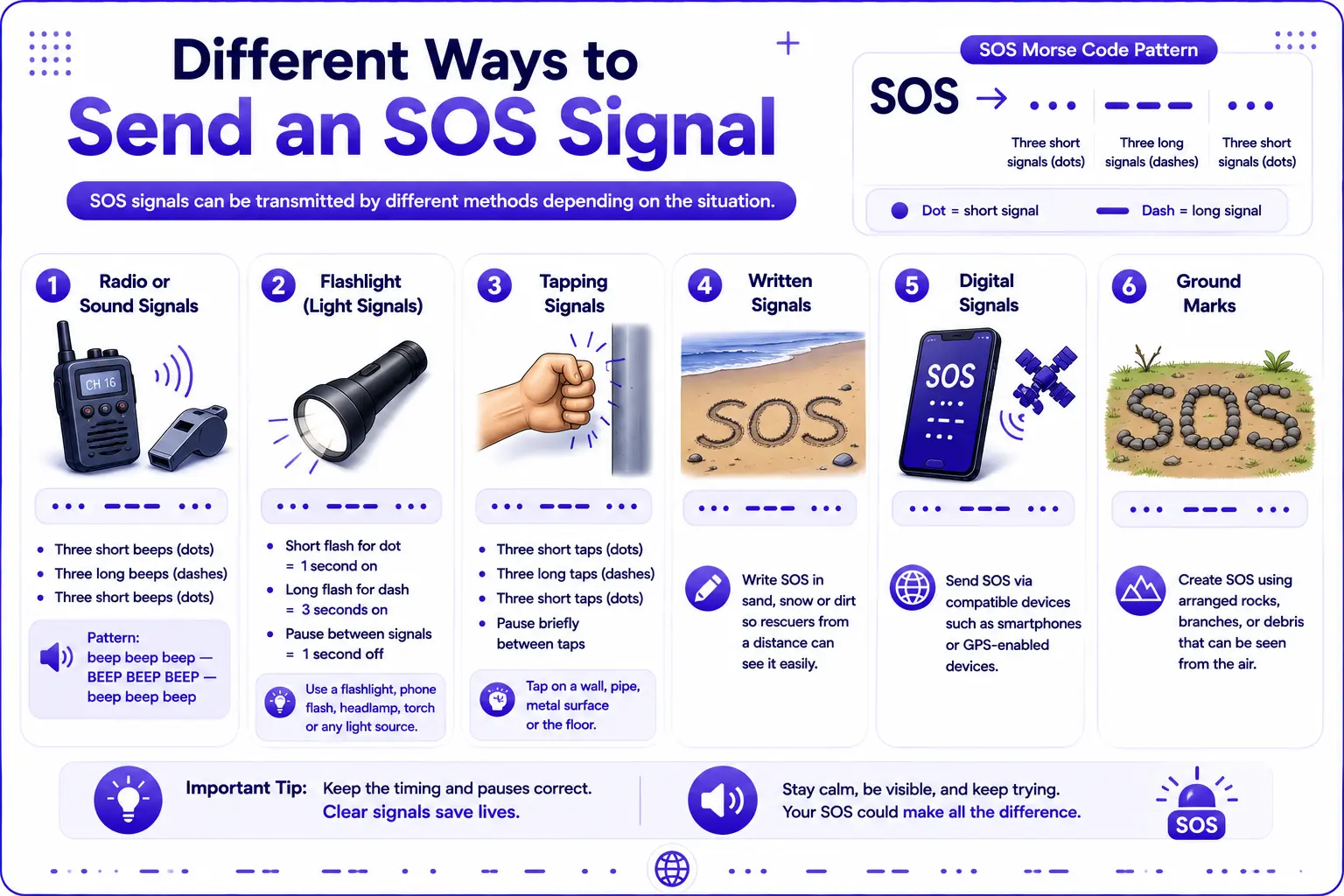
SOS signals can be transmitted by different methods depending on the situation.
Radio or sound signals
The classic SOS pattern can be transmitted using radio tones, a car horn, air horn, whistle, or buzzer.
- Three short beeps (dots)
- Three long beeps (dashes)
- Three short beeps (dots)
Pattern: beep beep beep — BEEP BEEP BEEP — beep beep beep
Flashlight
Distress signals can be sent using a phone flashlight or camera flash, a headlamp, dedicated signal light, torch, or another source of light.
- Short flash for a dot = 1 second on
- Long flash for a dash = 3 seconds on
- Pause between signals = 1 second off
Tapping
SOS can be transmitted by tapping on a wall, pipe, metal surface, or floor.
- Three short taps (dots)
- Three long taps (dashes)
- Three short taps (dots)
- Pause briefly between taps
Written signals
SOS can be communicated by writing it in sand, snow, or dirt so rescuers can see it from a distance.
Digital signals
An SOS message can be sent by compatible devices such as smartphones or GPS-enabled devices.
Ground marks
Emergency signals can be created by arranging rocks, branches, or debris into a large, visible SOS.
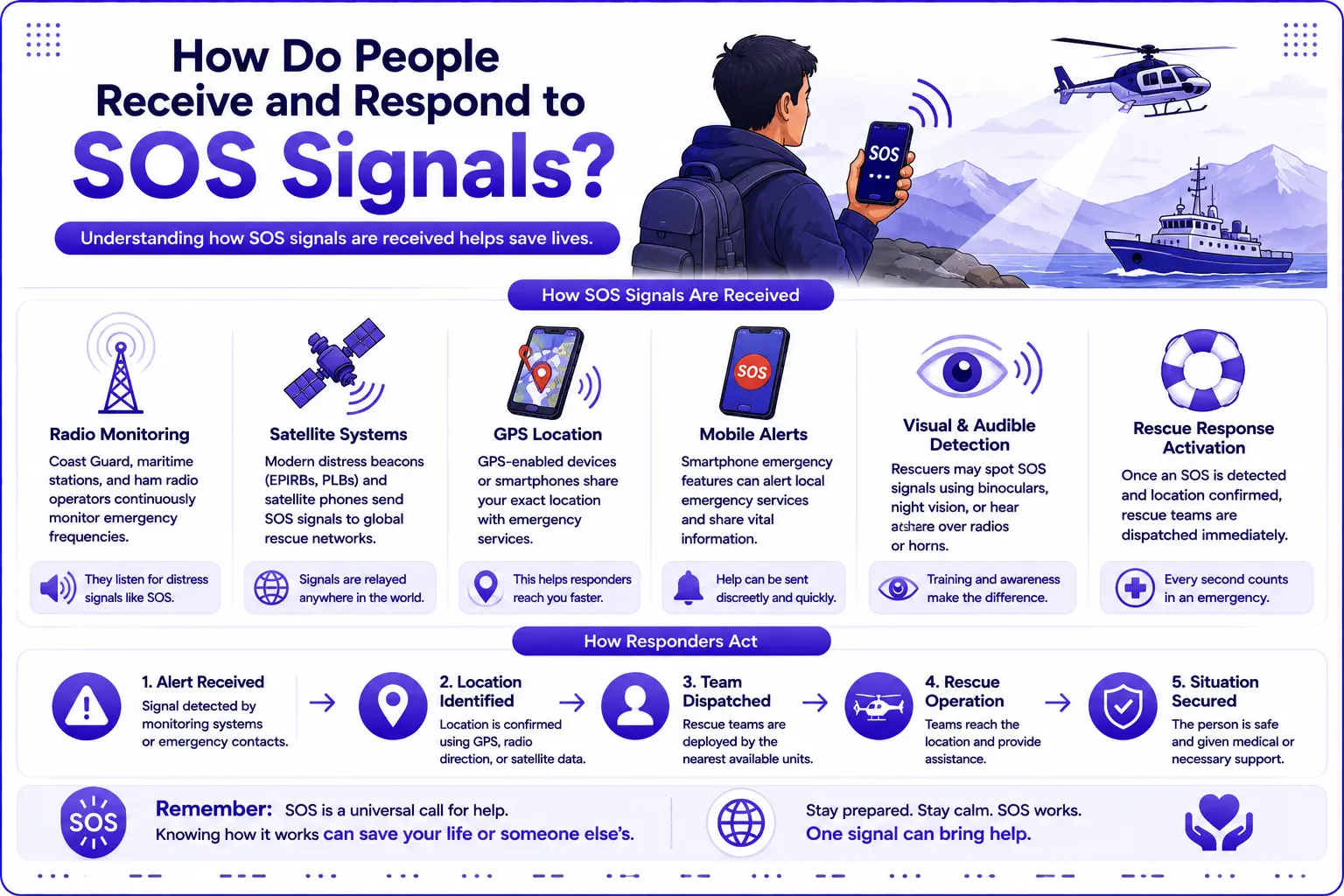
How Do People Receive and Respond to SOS Signals?
Today, SOS signals can be sent using modern technology, but the method depends on the situation. Understanding how these signals are received can help explain their importance in critical situations.
Emergency SOS via smartphone
Some modern smartphones, including iPhones, offer Emergency SOS functions that can:
- Dial local emergency services.
- Share your GPS location with responders.
When cellular networks are not available, some smartphones can connect via satellite to send SOS messages.
Radio Transmission (Maritime and Other Radios)
Distress communications can be transmitted over VHF maritime radio, including Channel 16, and may be received by nearby vessels and coastal authorities. This allows vessels in distress to request help even in remote areas.
Satellite Detection
An SOS alert can be sent through satellite-enabled devices:
Signal transmission: The device transmits SOS messages or alerts by radio signal.
Ground station relay: The satellite receives or relays the SOS communication to a ground station, where it can be processed and routed to rescue services.
Device → satellite → ground station → rescue service.
Requirements
A clear view of the sky is important for maintaining a reliable connection between a satellite and a device. Buildings, mountains, and other obstructions can weaken or block the satellite connection.
Response Process
Once the distress SOS signal is successfully sent and received:
- Emergency services can be alerted.
- Your location and situation details can be communicated to support a timely response.
By these methods, responders can receive information via radio, GPS, and phone devices.
In this receiving and responding process, timing and spacing are very important for accurate recognition. Follow these Morse code timing rules:
| Element | Duration |
|---|---|
| Dot | 1 unit |
| Dash | 3 units |
| The gap between signals within a letter | 1 unit |
| Gap between letters | 3 units |
| Gap between words | 7 units |
The Lifesaving Power of Knowing SOS
The SOS signal is a simple but powerful skill during a life-threatening situation. By understanding how to transmit and recognize these signals, you can:
- Signal for help when trapped under debris.
- Ask for assistance when stranded at sea or in deserted areas.
- Communicate during a hike when there is no network.
- Alert others quickly in dangerous situations.
- Improve your safety while traveling or navigating waterways.
Emergency Distress Signals Comparison
| Signal | Type | Usage | Status |
|---|---|---|---|
| SOS | Morse Code | Light, sound, radio tone | Still recognized |
| Mayday | Voice Call | Radio communication | Widely used |
| CQD | Morse Code | Early radio distress | Obsolete |
The Mayday distress signal is used for spoken radio distress calls, while SOS can be useful for non-verbal, visual, or sound situations.
Other Morse Code Signals
| Code | Meaning |
|---|---|
| ··· --- ··· | SOS — universal distress signal |
| -.-. --.- | CQ — calling all stations |
For short replies once contact is established, you can also learn YES in Morse code and NO in Morse code.
FAQs
Final Thoughts
Knowing the SOS signal is a useful safety skill because it can provide a simple way to request help, including when conventional communication devices are unavailable. Modern emergency devices such as phones, satellite devices, and digital distress beacons have changed how people request assistance, but SOS remains a universally recognized symbol of distress.