Morse code was developed in the 1830s by Samuel Morse and Alfred Vail as a communication system where letters and words are encoded using sequences of dots and dashes. Each letter has its unique code, allowing for simple and fast transmission, especially in critical situations. Today we’re learning about the word NO, which is very essential in everyday life; it sets clear boundaries, and it gives short and super fast answers.
In this guide, you’ll discover NO in Morse code, its meaning, different ways to send signals, timing rules, dramatic sound, and how to practice the word NO.
What is the word “NO” in Morse code?
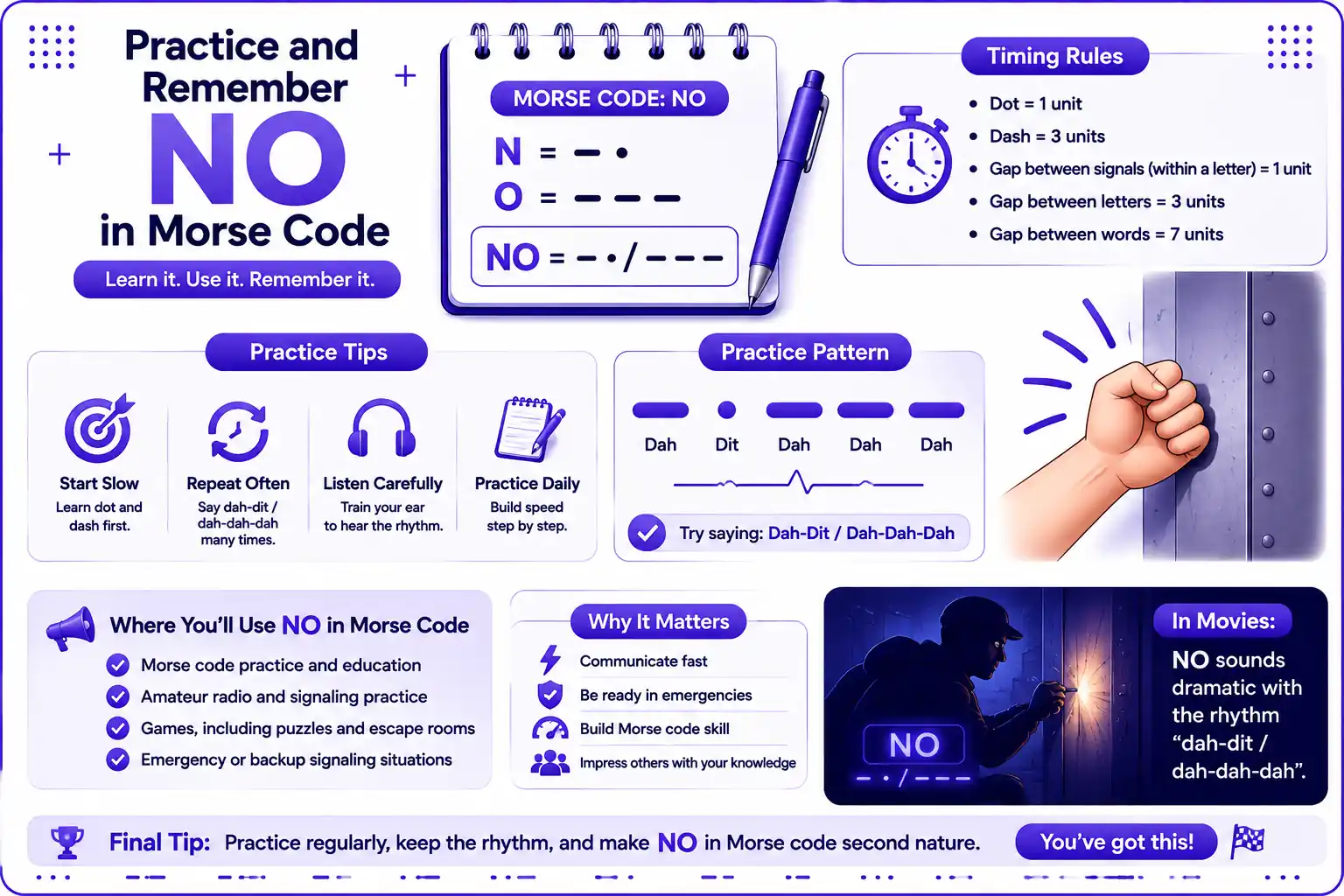
NO in Morse code, written as – · / – – –, spells out the word using the letters N and O. It starts and ends with a heavy dash and has just one dot in this whole pattern. Each dot and dash corresponds to a specific letter to form the word.
The letter N is represented by:
N = – ·
The letter O is represented by:
O = – – –
A simple way to remember NO is:
Dash → dot → dash → dash → dash
A short pause is very important to separate the letters.
When combined, both patterns form the Morse code sequence for the word NO.
| Character | Morse Code |
|---|---|
| N | -. |
| O | --- |
| NO | -. --- |
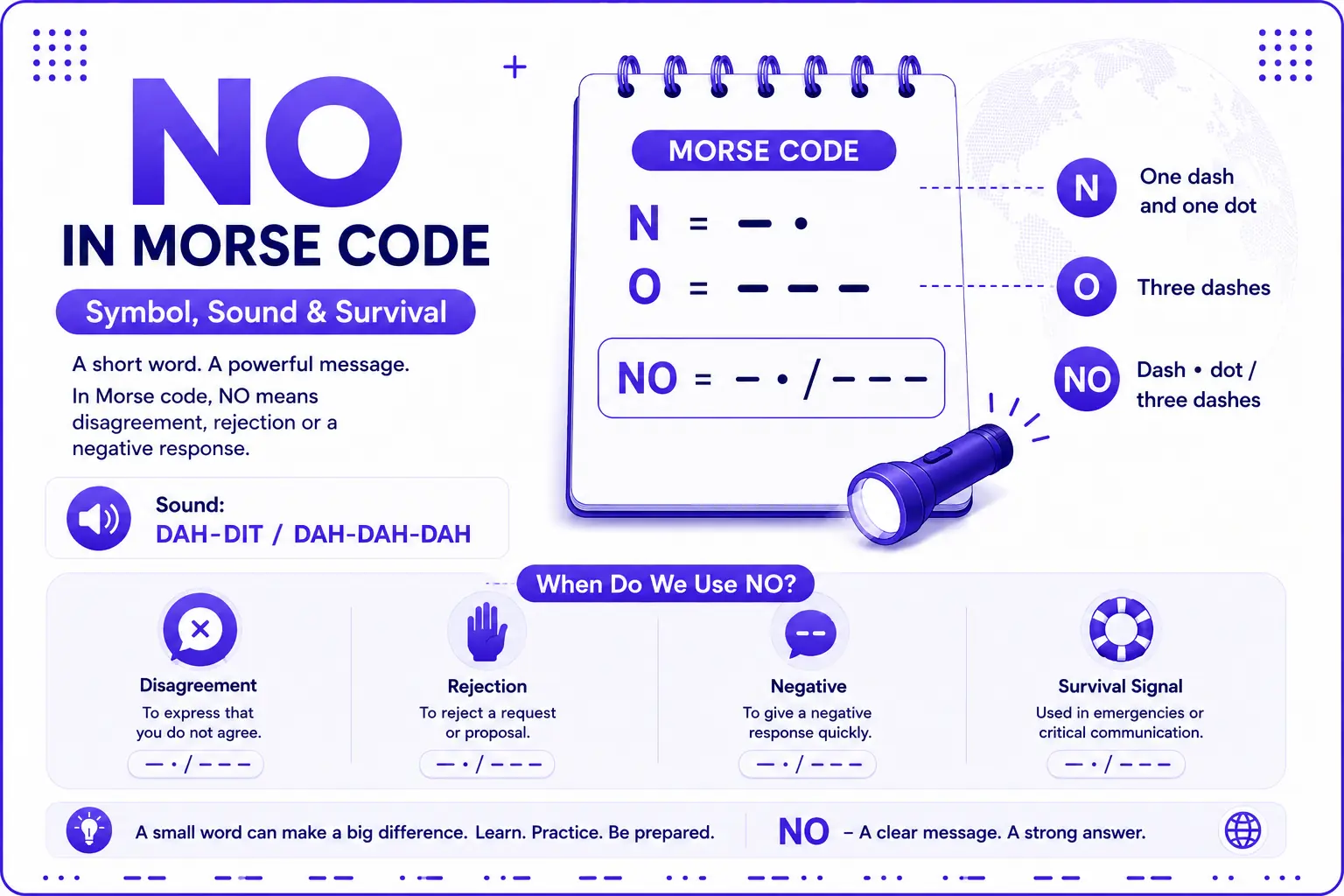
What Does NO Mean in Morse Code?
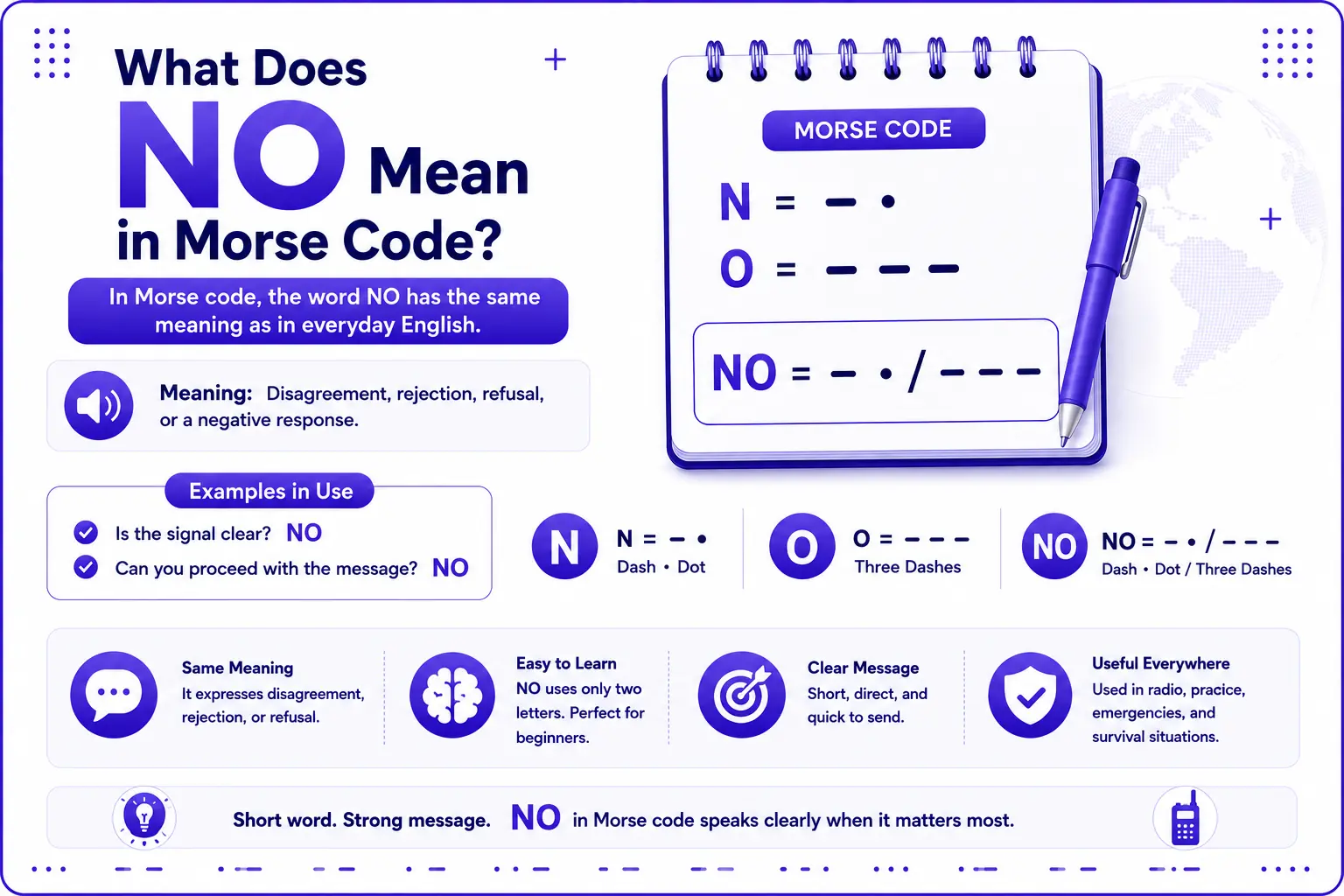
In Morse code, the word NO has the same meaning as it does in everyday English. It’s used to show disagreement, rejection, and refusal.
For the opposite affirmative response, see YES in Morse code.
Example:
- Is the signal clear? NO
- Can you proceed with the message? NO
This is an easy example of decoding Morse code back into plain text. If you’re a beginner, start practicing because it has just two letters.
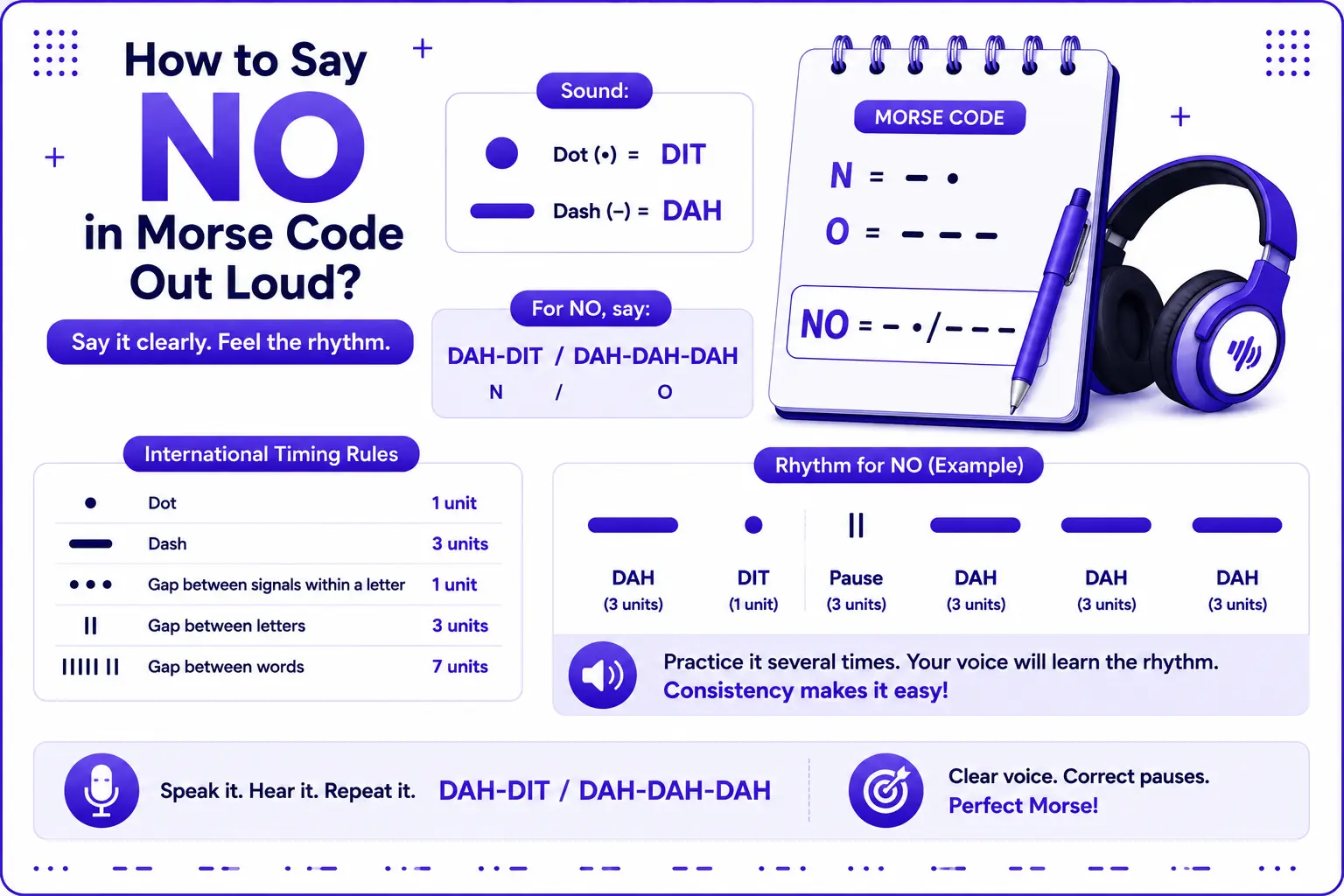
How to Say NO in Morse Code Out Loud?
When describing Morse code out loud, operators and learners commonly use the spoken sounds “dit” and “dah” for dots and dashes.
- Dot = dit
- Dash = dah
For NO, say: dah-dit / dah-dah-dah. Saying it out loud several times can help your brain learn the rhythm and remember the pattern more easily.
Keep in mind that when you pronounce or send the word NO, follow the International timing rules that define how long each signal lasts and how long each gap should be:
| Element | Duration |
|---|---|
| Dot | 1 unit |
| Dash | 3 units |
| The gap between signals within a letter | 1 unit |
| Gap between letters | 3 units |
| Gap between words | 7 units |
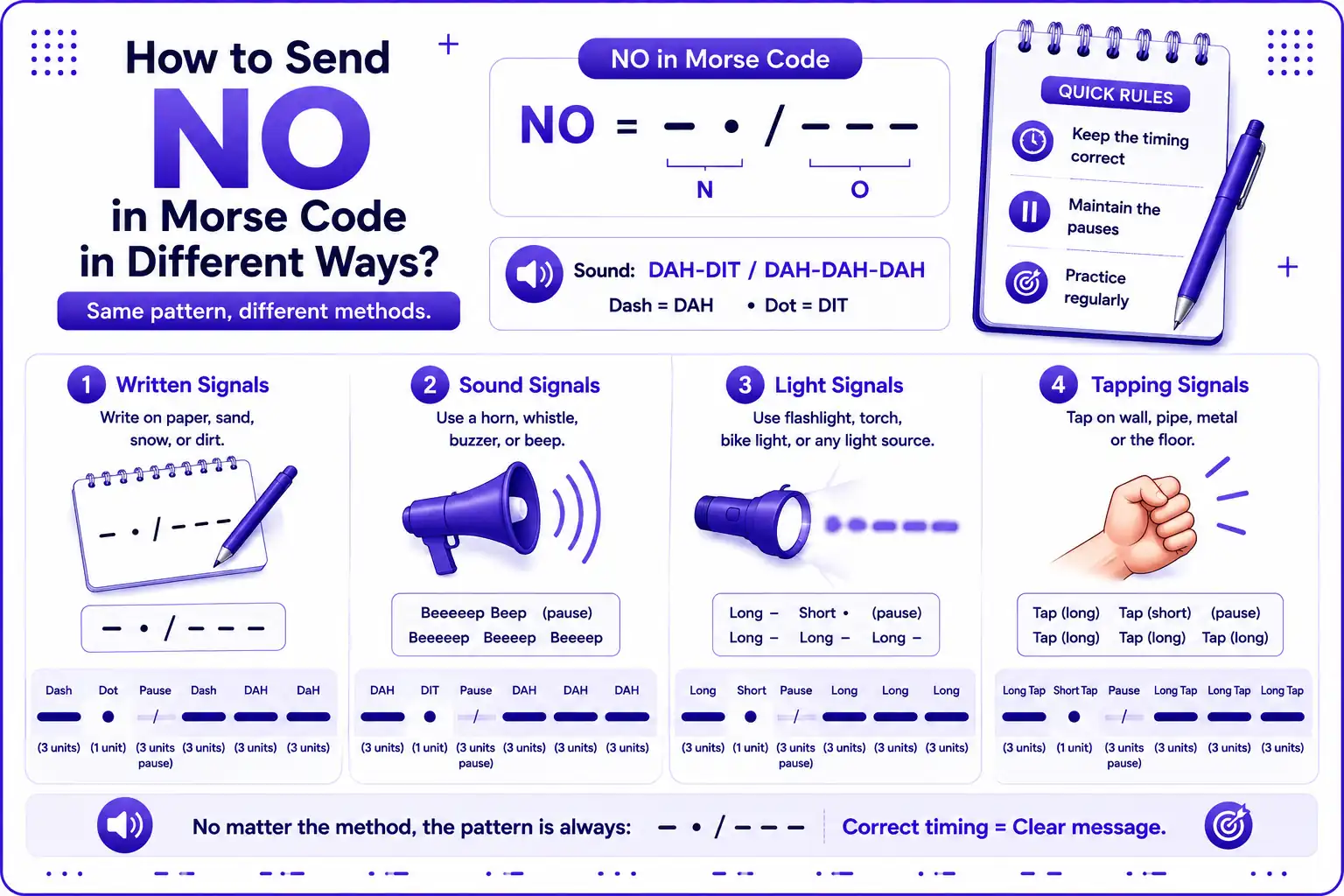
How to Send NO in Morse Code in Different Ways?
NO in Morse code can be transmitted in various ways, such as written signals, sound signals, light signals, and tapping signals. No matter what method is used to send a signal, follow the same pattern and timing for accurate decoding.
Before sending the pattern, you can verify it with our Morse Code Translator.
Written signals
NO in Morse code can be written on a piece of paper, sand, snow, or dirt. Write one solid dash and one tiny dot. Leave a space between the letters. Then write three solid dashes in a row. The slash below is only a visual separator between N and O; it is not part of the transmitted word.
– · / – – –
Sound signals
The NO pattern can be sent by a car horn, air horn, whistle, or buzzer.
- One long dash
- One short dot
- Pause between letters
- Three long dashes
Beeeeep Beep (pause) Beeeeep Beeeeep Beeeeep
Light signal
Light signals can be transmitted by using a phone flashlight or camera flash, a headlamp, torch, bike light, or another source of light. Use relative timing units rather than fixed seconds:
- Long flash for a dash = 3 units on
- Short flash for a dot = 1 unit on
- Gap between signals within a letter = 1 unit off
- Gap between N and O = 3 units off
For example, if you choose 1 second as one timing unit, a dot lasts 1 second and a dash lasts 3 seconds.
Tapping
NO can be sent by tapping on a wall, pipe, metal surface, or the floor, as long as the duration and pauses make the dot-and-dash pattern clear.
- Long tap (dash)
- Short tap (dot)
- Pause between letters
- Three long taps (dashes)
Why Does the Word NO Sound So Dramatic in Movies?
Morse code patterns are often shown in spy movies and survival games to represent secret communication. The dah-dit / dah-dah-dah pattern has a distinctive rhythm that can work well in intense movie scenes. It begins with a heavy beat and finishes with three long beats.
It can sound super dramatic when a character taps Morse code on a metal prison wall to escape evil bad guys in a movie scene. Its sharp rhythm and instant tension can create suspense for the audience and make the audience feel very nervous in the story.
Where You’ll Use NO in Morse Code?
You can use the word NO in Morse code in different situations, including:
- Morse code practice and education
- Amateur radio and signaling practice
- Games, including puzzles and escape rooms
- Emergency or backup signaling situations
For emergency signaling, it is also useful to understand the difference between HELP in Morse code and the internationally recognized SOS in Morse code.
Practice Tips for Learning NO in Morse Code
Regular practice is important when learning Morse code. Consistent training improves your ability to recognize and send signals accurately over time.
To reinforce the N and O patterns before practicing full words, review the Morse code alphabet.
Here are some tips to improve your learning and strengthen your memory:
- Listen to the sound.
- Spell simple words.
- Tap the pattern carefully.
- Say the pattern aloud.
- Use flashlights or finger taps.
- Use Morse code translator tools.
- Learn through social media resources.
- Practice writing phrases containing NO.
- Repeat the pattern at a faster speed.
- Practice 10-15 times daily.
Comparing NO With Other Short Words
If you’re a beginner and want to learn quickly, practice the word NO with other short words. It’s a useful way to train your recognition and sending skills.
| Secret Word | Morse Code Pattern | Why It Is Good for Practice |
|---|---|---|
| GO | – – · / – – – | It looks a lot like NO, but the first letter is slightly different. |
| HI | · · · · / · · | It is made entirely of dots. |
| NO | – · / – – – | It uses a mix of one dot and four dashes. |
| YES | – · – – / · / · · · | It is much longer and ends with three dots. |
| OK | – – – / – · – | It uses mostly dashes. |
Don’t Confuse NO With These Tricky Words
When you’re first learning the word NO, compare it with other letters and short words such as T, G, GO, and TO. Similar patterns can be easy to mix up at first:
The word GO
The word GO – – · / – – – and NO have the same O pattern, but the first letter is different. G is dah-dah-dit and N is dah-dit.
The Word TO
The word TO – / – – – looks a whole lot like NO. The letter T is just a single dash. If you accidentally omit the dot from N, you’ll transmit T instead, changing NO to TO.
Common Mistakes to Send NO
- Wrong spacing and pattern
- Confusing N with K
- Rushing the O
- Using N alone as NO
- Adding extra dots and dashes
FAQs
| Word | Morse Code |
|---|---|
| NO | -. --- |
| YES | -.-- . ... |