Morse code is a communication system developed in the 1830s by Samuel Morse and Alfred Vail. It has been used in civilian and military communications and represents letters, numbers, and punctuation through combinations of dots and dashes.
Today, we’ll explore the letter L in Morse code. We’ll cover its pattern, pronunciation, timing rules, practical uses, fun facts, and examples. This guide will help you understand and practice modern International Morse code.
Practice the pattern interactively with our Morse code translator, listen with the audio translator, and compare it with the complete Morse code alphabet.
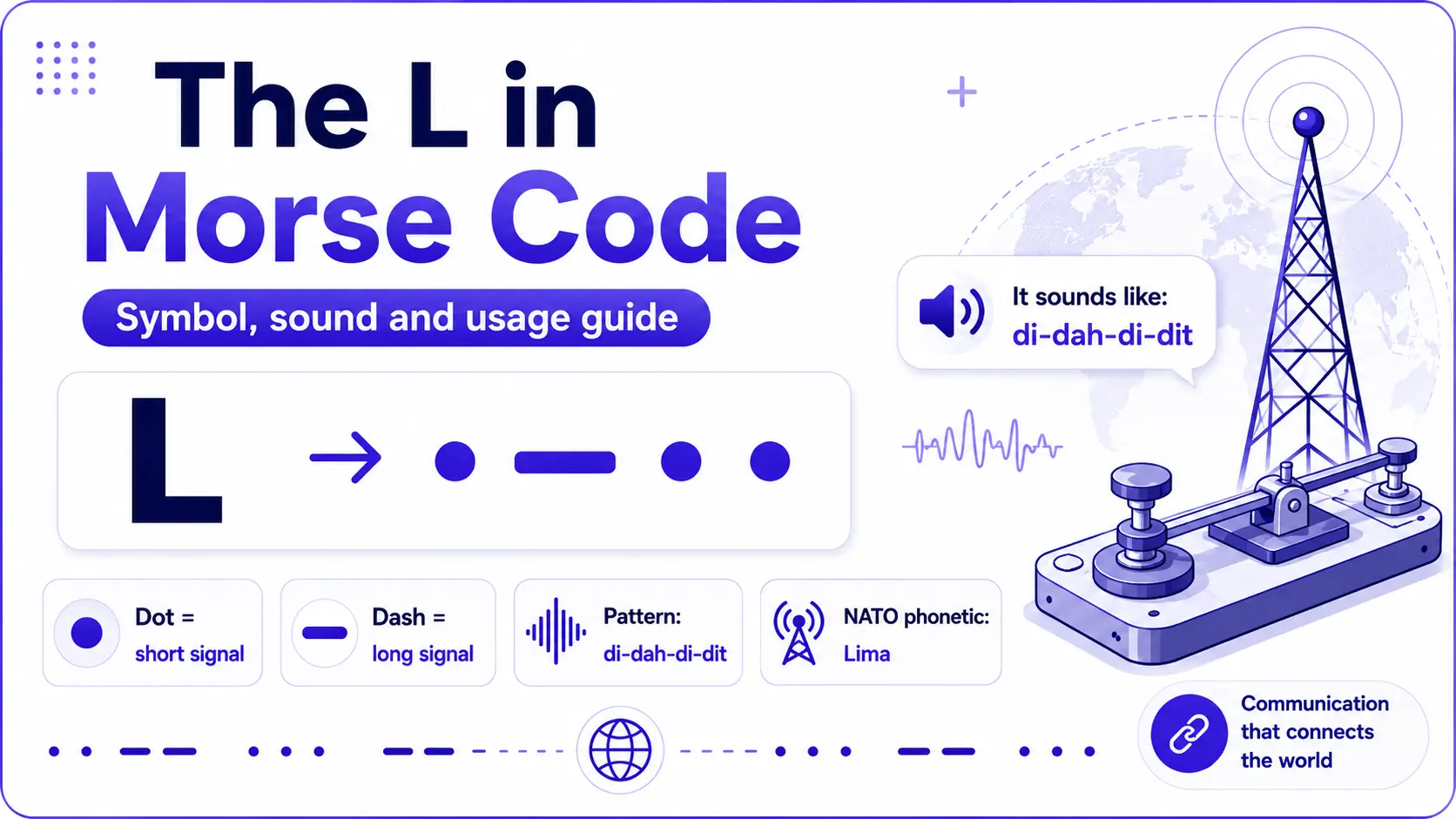
At a Glance
| Item | Details |
|---|---|
| Character | L |
| Morse Code | .-.. |
| Spoken | di-dah-di-dit |
| Type | Latin letter |
| ICAO/NATO Phonetic | Lima |
| Symbol Count | 4 |
What Is the Morse Code for L?
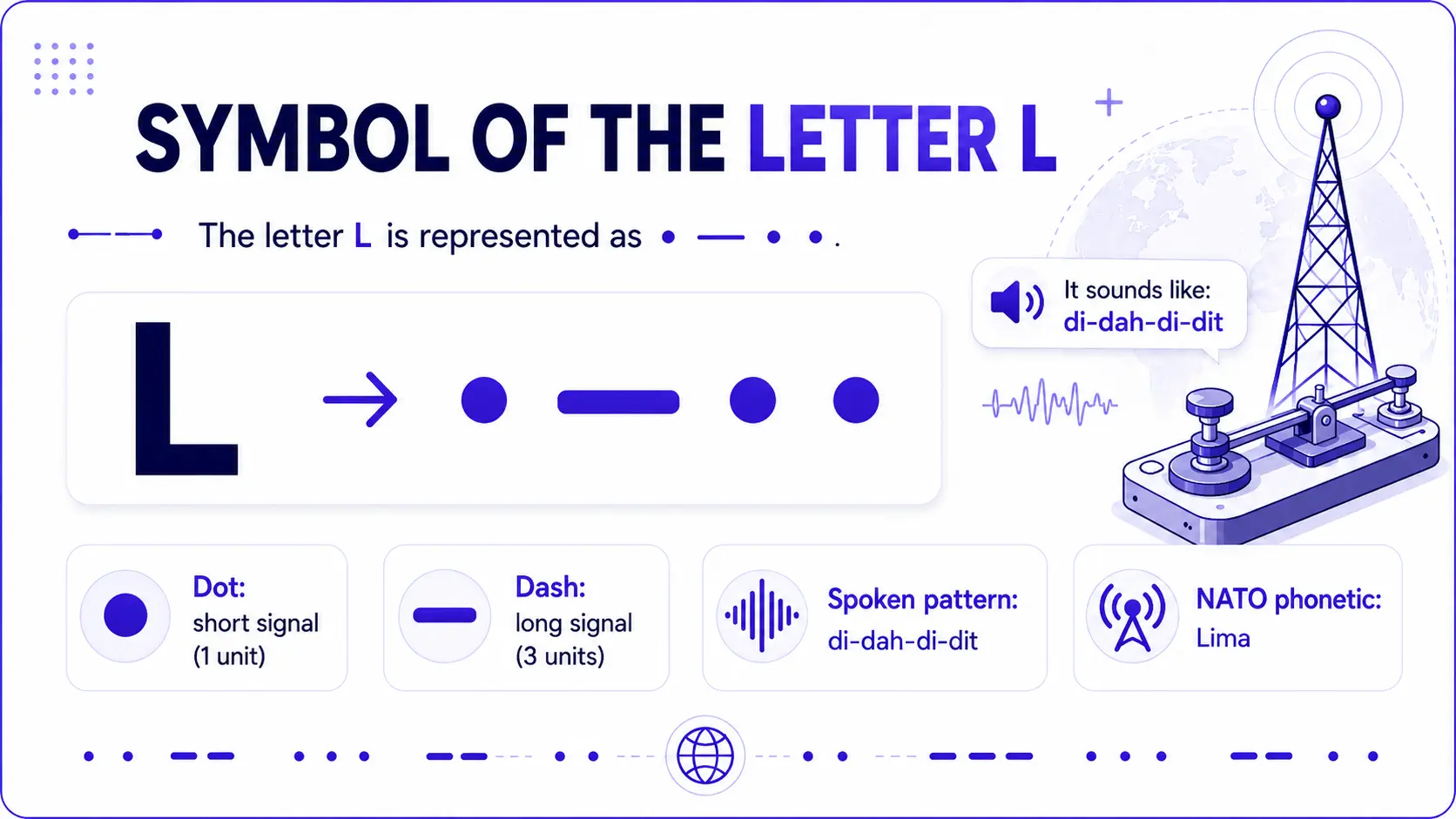
International Morse code represents the letter L as · — · ·. A dot is a short signal, and a dash is a long signal. The pattern is commonly spoken as “di-dah-di-dit.” The ICAO/NATO phonetic alphabet word for L is “Lima.”
The sequence is: Dot → Dash → Dot → Dot.
Timing Rules
Proper timing and spacing make Morse code easier to decode accurately. When sending the letter L, follow these standard timing relationships:
- Dot (.) = 1 time unit
- Dash (-) = 3 time units
- Gap between dots and dashes within the same letter = 1 unit
- Gap between letters = 3 units
- Gap between words = 7 units
Consistent timing helps listeners recognize each character clearly and reduces decoding errors.
Example: LOVE in Morse Code
| Letter | Morse Code | Spoken (Pronunciation) |
|---|---|---|
| L | · — · · | dit-dah-dit-dit |
| O | — — — | dah-dah-dah |
| V | · · · — | dit-dit-dit-dah |
| E | · | dit |
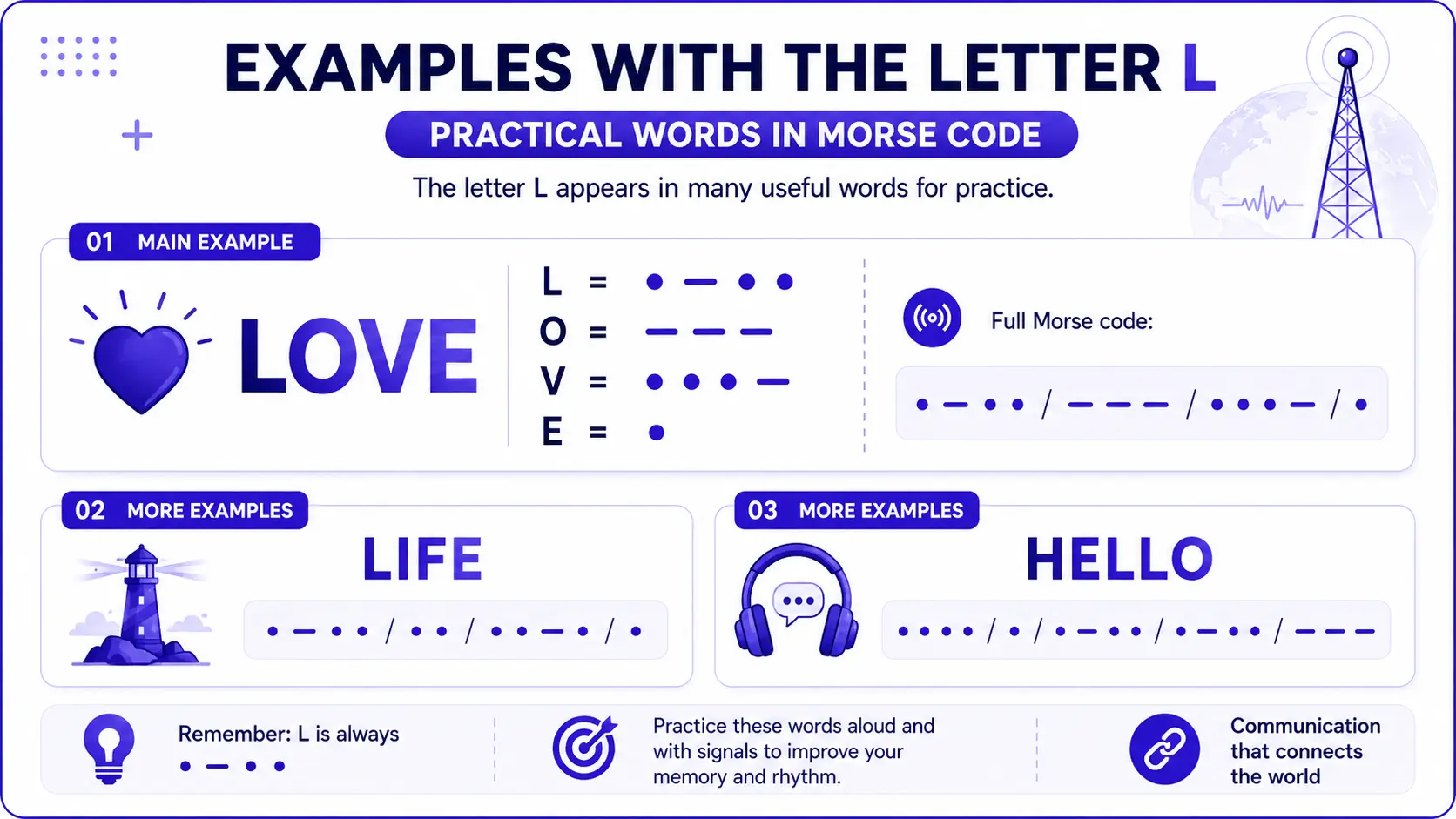
Full Morse code for LOVE: · — · · / — — — / · · · — / ·
Full spoken sequence: dit-dah-dit-dit / dah-dah-dah / dit-dit-dit-dah / dit
How to Write and Send the Letter L in Morse Code
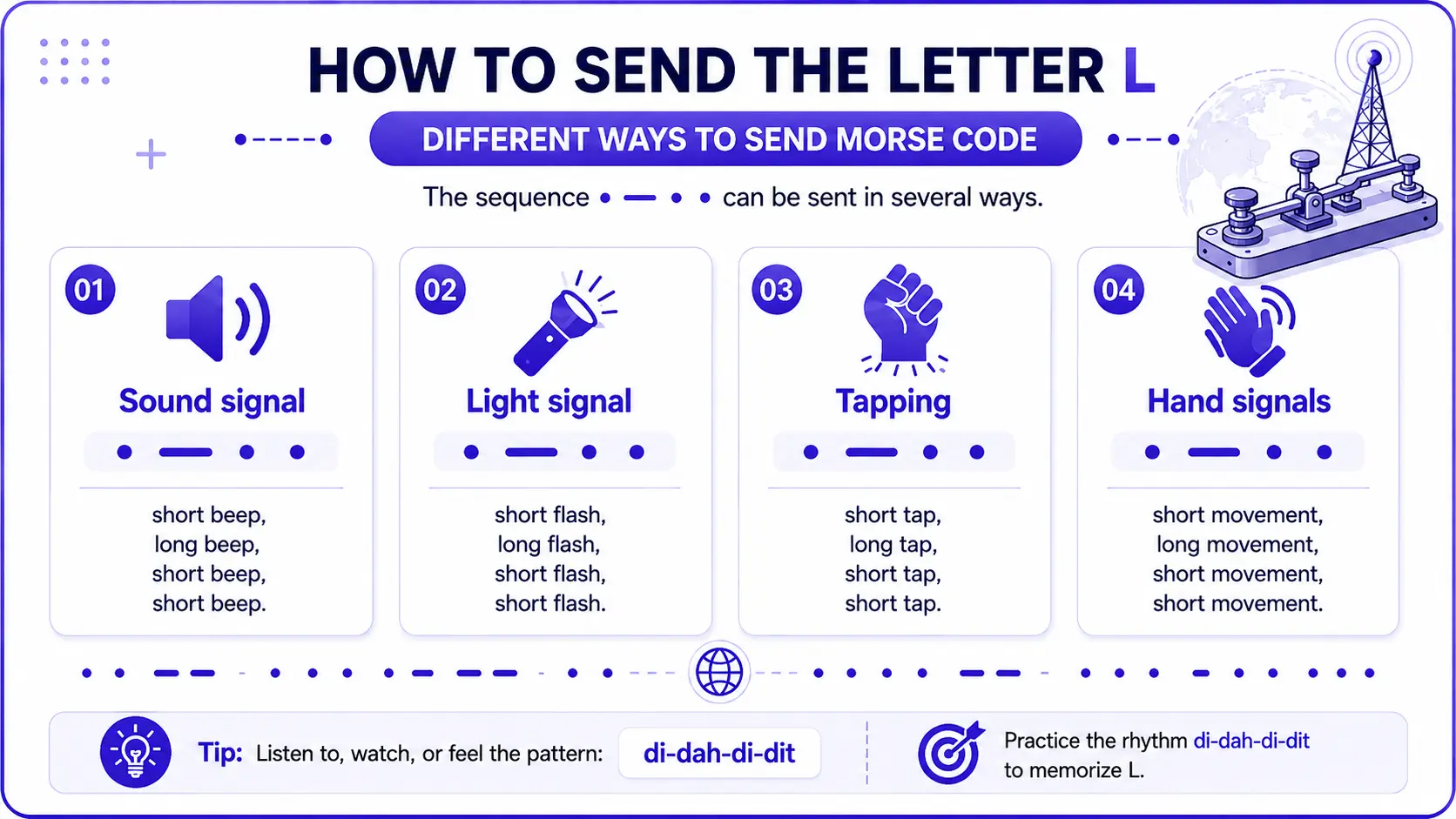
The letter L has a clear pattern. You can recognize it through writing, hearing, light signals, or tapping. Here are practical methods:
Writing: Mark one dot, one dash, and two dots: · — · ·
Listening: Listen for one short beep, one long beep, and two short beeps: short… long… short… short. You can use a buzzer, whistle, or tone generator to practice the rhythm.
Light signals: Turn on a flashlight or signal lamp briefly for a dot and for a longer duration for a dash. Repeat the sequence to complete the letter.
Tapping: Make one short tap, one longer tap, and two short taps. Keep the timing consistent so the sequence is easy to understand.
Fun Facts About L in Morse Code
Musical Sound
You can turn Morse timing into a simple rhythm: a short note for a dot and a long note for a dash. This makes the pattern for L a useful rhythmic mnemonic.
Binary Code
Morse code can be represented digitally—for example, by using 0 for a dot and 1 for a dash—but that convention is not part of the Morse standard. Separately, the uppercase letter L is 01001100 in 8-bit ASCII. These are different encoding systems.
Tattoos
Some people use the Morse pattern for L, · — · ·, in tattoos as a stylish design with a personal or hidden meaning.
Fun Activities to Practice L
To practice with friends, try these simple activities:
Games and puzzles: Tap the letter L or a word containing L on a desk. Ask a friend to identify the pattern or use it to build words such as LIFE or LEARN.
Flashlight messages: Use a device’s flashlight. Turn it on briefly for dots and longer for dashes, then ask someone to guess the letter.
Audio quizzes: Record Morse code sequences and test yourself on identifying L.
Emotional Significance
A popular creative use of the letter L is in the abbreviation ILY (“I love you”) written in Morse code. It can be used to express affection in messages, jewelry, or artwork.
Breaking Down I, L, and Y
Here is how to write ILY using the Morse code for each letter:
- I: · ·
- L: · — · ·
- Y: — · — —
Morse code itself has no emotional meaning; the significance comes from the phrase represented by the letters.
Practical Applications of L in Morse Code
Although modern digital systems dominate communications, Morse code remains useful in applications that rely on simple, recognizable signals.
Amateur Radio Operators
Many amateur radio operators use Morse code, often called CW, along with abbreviations that support quick communication. One common term is YL, meaning “young lady,” which is used for a female amateur radio operator.
Aviation
Radio navigation aids such as VORs and localizers transmit coded identifiers that pilots use to confirm they have selected the correct facility. If an identifier contains L, that part is transmitted as · — · ·.
Pilots compare the full received identifier with the identifier shown on the appropriate chart or navigation display. The complete identifier—not the letter L alone—confirms the facility.
Navigation
Historically, ships used Morse code for ship-to-ship and ship-to-shore communication. Individual letters, including L, could appear in call signs and message text.
Some maritime radio beacons and navigation aids have also transmitted coded identifiers. When an identifier includes L, it is sent as · — · ·. Users should verify the complete identifier against an official chart or publication rather than relying on one letter alone.
World War II
During World War II, Morse code played an important role in military communications for naval, ground, and air forces. Individual letters such as L appeared as parts of messages, call signs, and encoded information.
Jewelry
Some people use the Morse code pattern for L, · — · ·, on lockets, bracelets, and rings to represent the initial of a person’s name.
It can serve as a decorative, personalized design and may also symbolize meaningful words that begin with L, such as love, luck, and life.
Example: A ring can use a bead pattern to show the letter L as · — · ·.
Emergency Signaling
When ordinary communication methods are unavailable, Morse code can be sent through sound, light, or tapping. However, the letter L alone is not a standard distress signal.
The word HELP is written as .... / . / .-.. / .--. (· · · · / · / · — · · / · — — ·). The internationally recognized distress signal SOS is ... --- ... (· · · / — — — / · · ·).
In a real emergency, use approved emergency equipment and official procedures whenever they are available.
Using Morse Code Translators
For beginners, a Morse code translator can be a useful practice tool. You can use it to:
- Enter a letter or word to see its Morse code equivalent.
- Use audio playback to hear the difference between short and long signals.
- Practice letter spacing and word spacing with complete phrases.
For example, entering the letter L will show · — · ·. You can also enter a phrase such as “please help me” to see and hear the complete message.
Words Containing L
Here are common words that can help you practice the letter L in context:
| Word | Morse Code | Why It’s Useful |
|---|---|---|
| LOVE | · — · · / — — — / · · · — / · | A familiar word that combines four different letter patterns. |
| LIFE | · — · · / · · / · · — · / · | A common word with short, varied patterns. |
| LIGHT | · — · · / · · / — — · / · · · · / — | Useful for practicing five different letters. |
| HELLO | · · · · / · / · — · · / · — · · / — — — | A universal greeting with L repeated twice. |
| WILL | · — — / · · / · — · · / · — · · | Useful for practicing repeated L patterns. |
| HELP | · · · · / · / · — · · / · — — · | A useful word for practicing clear letter spacing. |
| SMILE | · · · / — — / · · / · — · · / · | A positive word with varied rhythms. |
Practice Tips
Repetition: Say “di-dah-di-dit” aloud while reading · — · ·, and practice it 20–30 times. Learning the pattern as a rhythm makes it easier to memorize.
Short words: Begin with short, simple words such as LIP, LID, and LEG in Morse code. These exercises can help you recognize L in context.
Writing practice: Write L in Morse code several times in a notebook and focus on the dot-and-dash pattern. Compare it with other letters to strengthen recognition.
Listening: Use an online Morse code player or app and listen to the pattern repeatedly. Hearing “dit-dah-dit-dit” will reinforce your memory.
Common Mistakes When Learning L
Beginners may confuse L with similar characters when timing or spacing is inconsistent.
Dot-and-Dash Confusion
The length of the dot and dash matters. If the dash in .-.. is shortened until it sounds like a dot, the pattern may be heard as ...., which is H.
The fix: When sending L, count the dot as one unit and the dash as three units. This reinforces that the dash is three times as long as the dot.
Spacing Errors
Incorrect pauses between symbols and letters can make a message difficult to decode. For example, when sending L followed by J (· — · · / · — — —), the receiver needs a clear letter gap to know where L ends and J begins.
The fix: Leave a three-unit gap after completing L before starting the next letter.
Mixing Up Similar Codes
R (· — ·) and L (· — · ·) are similar, but L has one additional dot at the end. Careful listening helps distinguish the two patterns.
The fix: Remember that L has an “extra beat” at the end. “Dit-dah-dit” is R, while “dit-dah-dit-dit” is L.
FAQs
Related Morse Code Guides
Final Thoughts
The letter L is straightforward to learn and can help improve Morse code recognition and decoding speed. Once you are comfortable with the individual letter, move on to short messages, timed listening exercises, and mixed-character drills. That progression turns basic recognition into a practical communication skill.