Morse code is a communication system that uses short signals (dots) and long signals (dashes) to represent letters and numbers. It has been used to send information through radio, satellites, telegraph systems, and light signals.
If you want to learn the letter K in Morse code and understand its unique visual pattern, this guide explains everything you need to know, including its meaning, pronunciation, examples, learning methods, and practical uses.
At a Glance
| Element | Details |
|---|---|
| Character | K |
| Morse Code | -.- |
| Spoken | Dah-Dit-Dah |
| NATO Phonetic | Kilo |
| Symbol Count | 3 |
| Type | Latin letter |
What Is K in Morse Code?
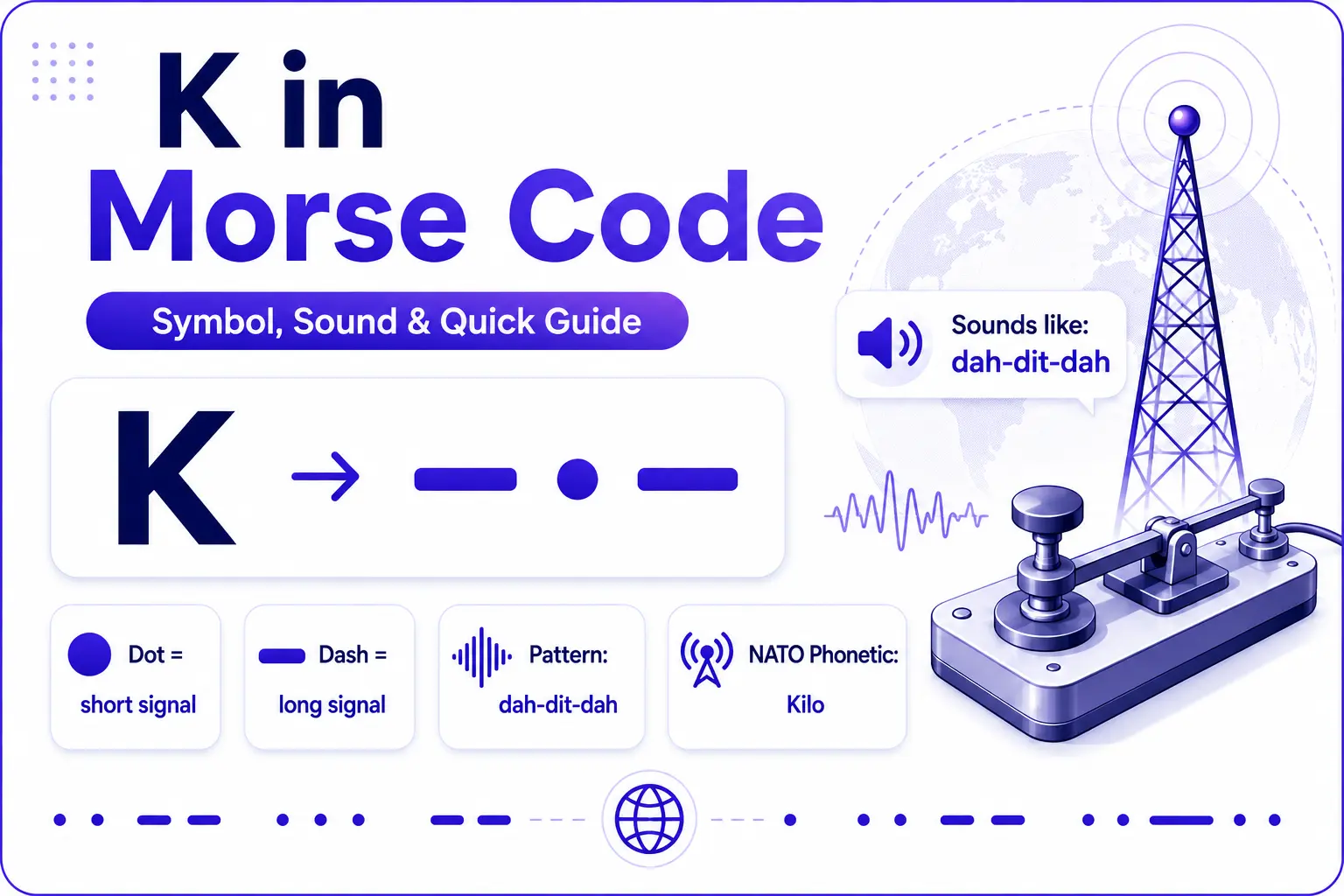
In Morse code communication, the letter K is used as a procedural signal meaning “go ahead” or “your turn to transmit.” It allows another operator to begin sending a message.
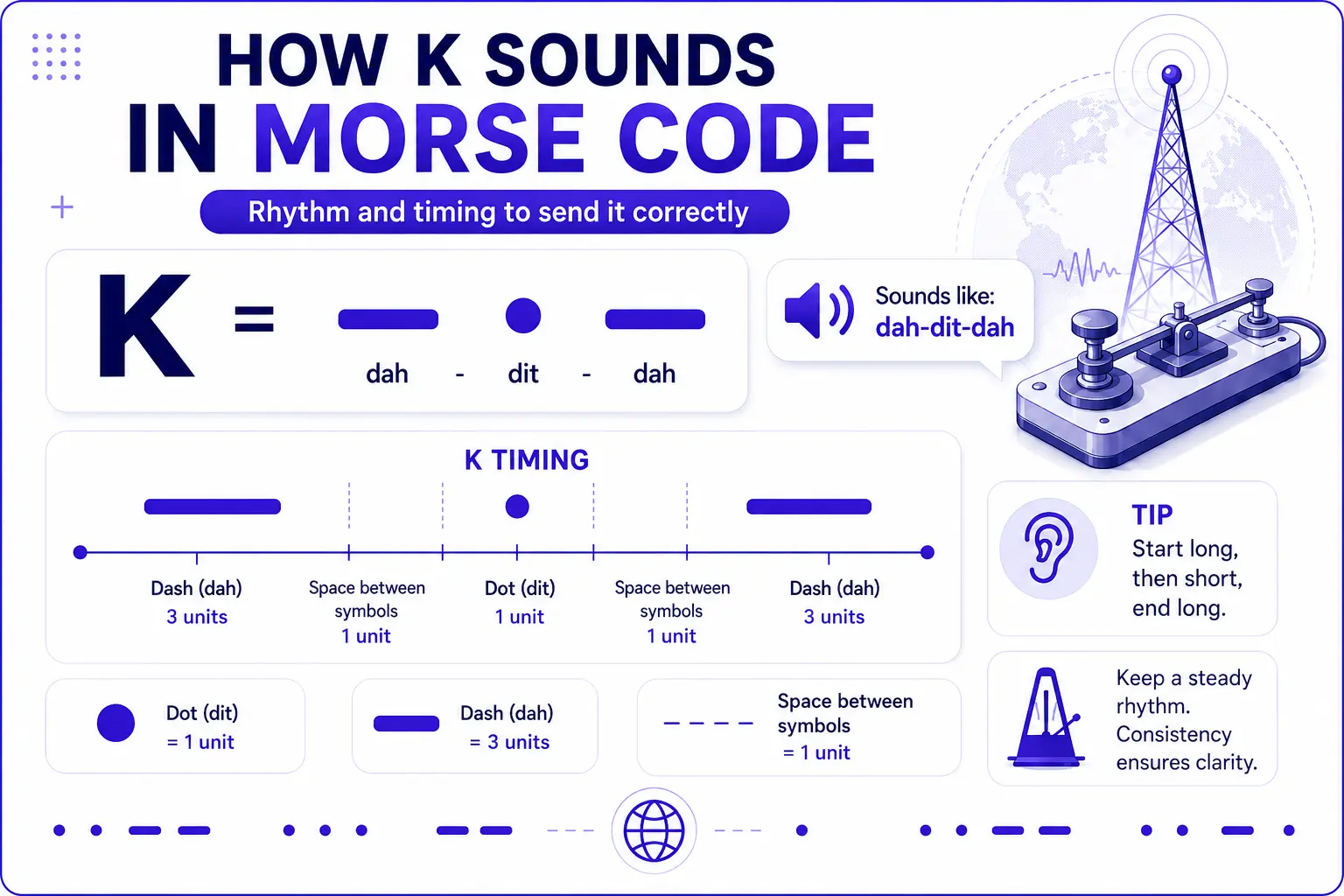
The letter K in Morse code is written as – · –. It consists of one dash, followed by one dot, and ends with another dash. It is pronounced Dah-Dit-Dah.
K has a symmetrical pattern because the same symbol appears at both ends, with one dot in the middle.
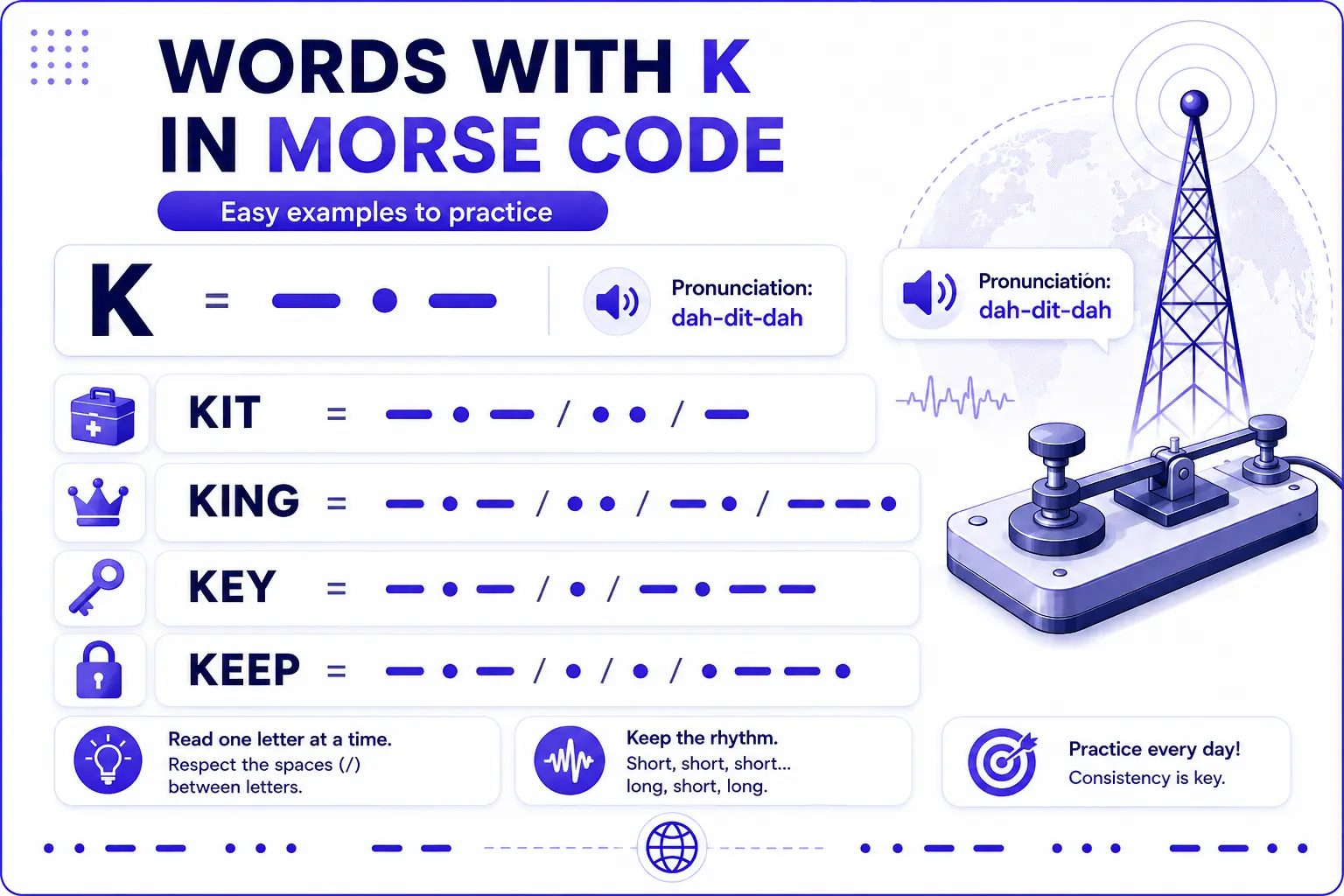
The Word “KIT”
Let us try a word that starts with the letter K:
- K is: – · – (Dah-Dit-Dah)
- I is: · · (Dit-Dit)
- T is: – (Dah)
Together, the word “KIT” looks like this:
The Word “KING”
Let us try a four-letter word that starts with the letter K:
- K is: – · – (Dah-Dit-Dah)
- I is: · · (Dit-Dit)
- N is: – · (Dah-Dit)
- G is: – – · (Dah-Dah-Dit)
Together, the word “KING” looks like this:
How to Learn K in Morse Code
If you are a beginner and do not know how to write K in Morse code, these methods will help you learn it easily.
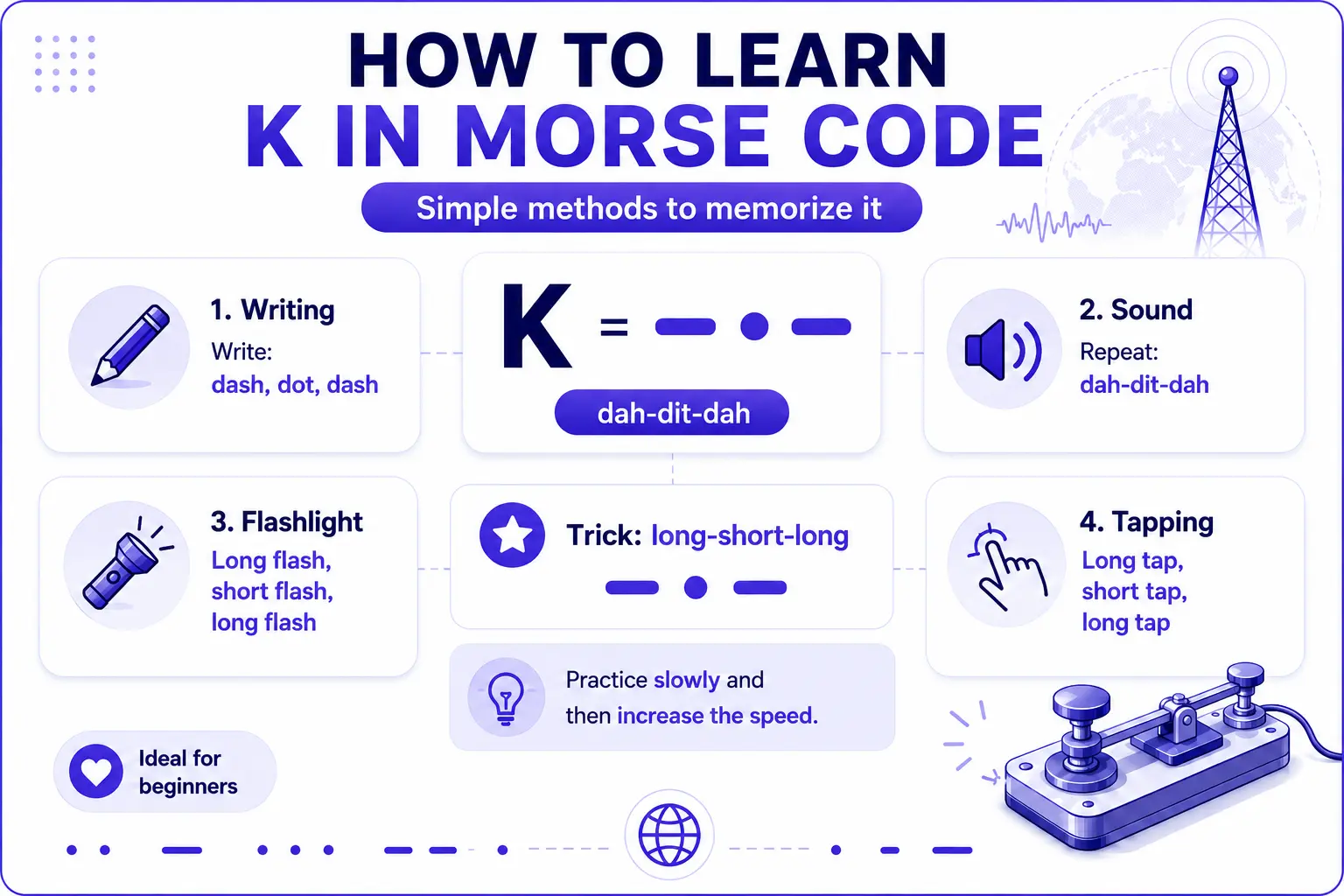
Writing
Write one dash, one small dot, and another dash:
Sound
Say the pattern aloud as Dah-Dit-Dah by making one long sound, followed by a short sound, and ending with another long sound:
Long beep → short beep → long beep
Flashlight
Use a long flash to represent a dash and a short flash to represent a dot. For the letter K, flash the light in this order:
Long flash → short flash → long flash
Tapping
Use a long tap on a hard or wooden surface to represent a dash, followed by a short tap for the dot, and then another long tap for the final dash:
- Long tap
- Short tap
- Long tap
Listening
Listen to the sound of a dash, a dot, and another dash using a buzzer or whistle:
Dash → Dot → Dash
One of the best ways to learn Morse code is by listening. Focus on the rhythm instead of counting each symbol. It is also important to maintain the correct sequence of dots and dashes for clear communication.
Why the “Dah-Dit-Dah” Sound Is So Dramatic in Movies
Morse code patterns are often shown in spy movies and survival games to represent secret communication. The Dah-Dit-Dah pattern is perfectly symmetrical, which makes it suitable for intense movie scenes.
It begins with a long beat, drops to a short beat, and ends with another long beat. The balanced rhythm of Dah-Dit-Dah makes the pattern easy to recognize, which is one reason Morse code is often used in movies and games to represent secret communication.
When a character taps Morse code on a metal prison wall in a movie scene, the sharp rhythm can create suspense for the audience.
Using K in Secret Messages
The letter K has an interesting Morse code pattern that people can use for fun in classroom activities, drawings, puzzles, coded games, and hidden messages.
For example:
KEY = -.- . -.--
You can show this code to your friends and ask them what it means.
Only someone who knows Morse code will be able to understand the secret message. This makes Morse code an entertaining way to create simple coded notes with friends.
You can use the Morse code pattern for K in many contexts, such as:
- Coding
- Technology
- Educational apps
- Online translator tools
- Social media and pop culture
- Games, including puzzles and escape rooms
- Emergency and real-life situations
Tricky Letters
When learning the Morse code alphabet, some letters may appear similar and confuse beginners. Pay close attention to these tricky letters and learn the differences between their patterns.
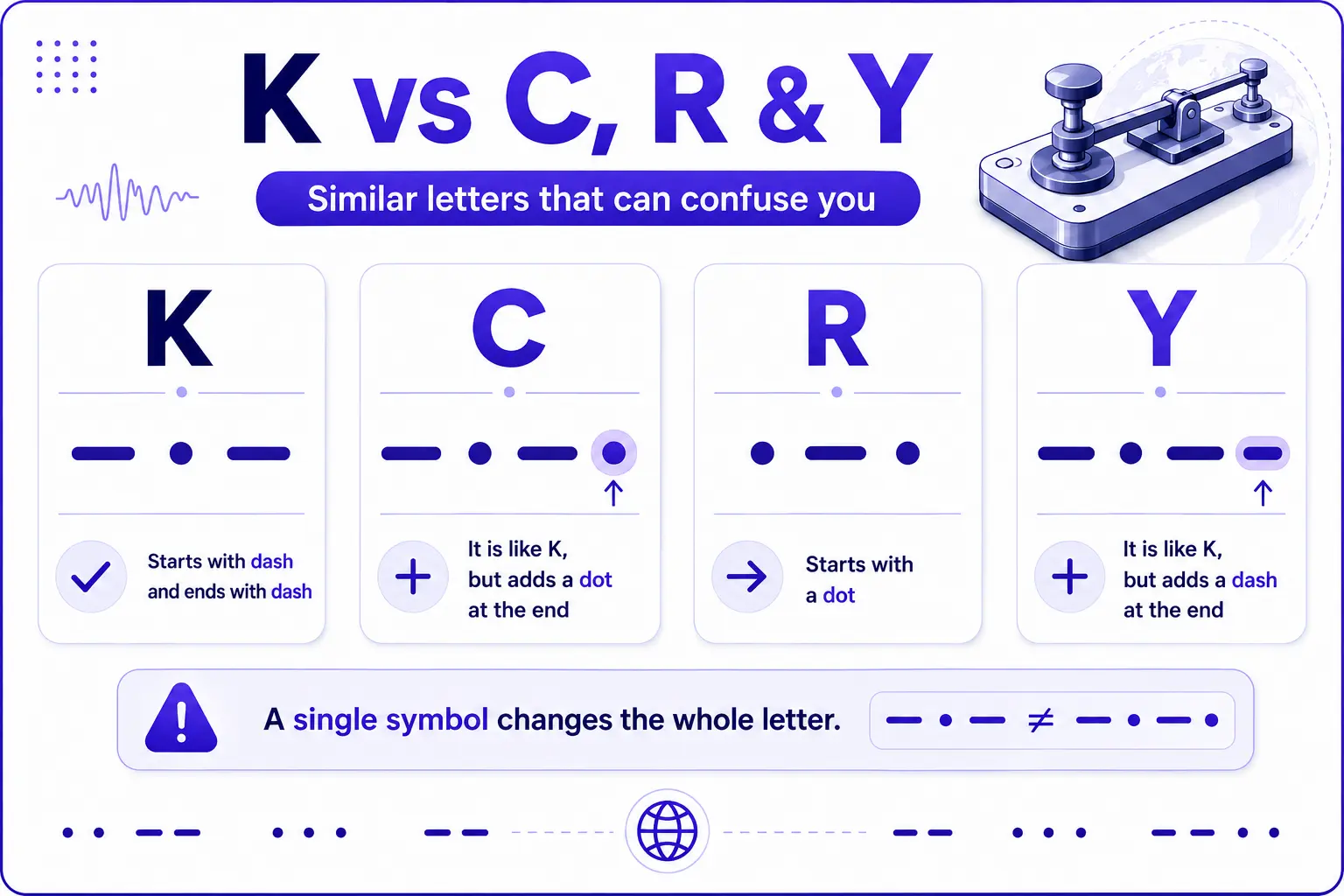
K can be confused with letters such as C, R, and Y because their Morse code patterns are similar.
K vs. C
K and C can be confused with each other, but C has an extra dot.
- K is represented as – · –
- C is represented as – · – ·
The extra dot at the end makes C different from K. A small mistake can result in the wrong Morse code character.
K vs. R
K and R have different patterns that can confuse beginners.
- K starts with a dash: – · –
- R starts with a dot: · – ·
Their sequences are reversed. When sending R, begin with a short signal because it starts with a dot. When transmitting K, begin with a long signal because it starts with a dash.
K vs. Y
The letter Y begins with the same pattern as K but adds an extra dash at the end.
- K is written as – · –
- Y is written as – · – –
The pattern for Y is pronounced Dah-Dit-Dah-Dah. Remember that Y has one additional dash at the end.
Practical Applications of K in Morse Code
Morse code has practical applications in areas such as radio operations, maritime communication, education, and jewelry.
Amateur Radio (Ham Radio)
In amateur radio, K is a procedural signal meaning “go ahead” or “your turn to transmit.” This type of signal is called a prosign.
To communicate “I am ready to receive your message,” an operator can send K. There is no need to spell out the word “Over.” The other operator receives the signal and knows that it is their turn to transmit.
Maritime Communication
Navies have used signal lamps for line-of-sight communication. Signal lamps have also been used in training and by scouting groups, including Boy Scout troops.
They can be used to transmit navigation updates, warnings, and identification signals.
Jewelry
Some people use the Morse code pattern for K, – · –, in jewelry such as lockets, bracelets, and rings to represent a name, word, or personal meaning.
It can symbolize a meaningful word or a special name that starts with K.
Example: A locket with a bead pattern representing – · – displays the letter K.
Using Morse Code Translators
If you are a beginner and want to learn Morse code, a translator tool can be useful for practicing and developing your Morse code skills.
When you type the letter K into a translator, the tool will immediately display the correct pattern. You can also enter complete words or phrases to practise character spacing and view the translation of the entire message.
A clean and user-friendly interface can make it easier to memorize the pattern. You can copy the result, paste it into an email, and share it on different platforms.
Practising With Simple Words Containing the Letter K
Here are some simple words that contain the letter K so that you can practise recognizing and sending it:
| Word | Morse Code |
|---|---|
| Kid | -.- .. -.. |
| Kit | -.- .. - |
| King | -.- .. -. --. |
| Keep | -.- . . .--. |
| Kick | -.- .. -.-. -.- |
How Does Morse Code Timing Work for K?
Timing is at the core of Morse code. It determines how long each signal lasts and how long each gap should be. The dot is used as the basic unit of time.
| Element | Duration |
|---|---|
| Dot | 1 unit |
| Dash | 3 units |
| Gap between signals within a letter | 1 unit |
| Gap between letters | 3 units |
| Gap between words | 7 units |
When transmitting the letter K, the sender should maintain steady timing. This helps the receiver distinguish K from other Morse code characters and decode it correctly.
Fun Activities to Learn Morse Code
Learning a new communication system can feel difficult or overwhelming at first. Dots and dashes may initially seem confusing, but mnemonics and memory tricks can make Morse code easier to learn.
Musical Sandwich
To become familiar with Morse code, try connecting its patterns with everyday objects and memorable examples.
The long-short-long pattern of K can be visualized as a sandwich:
- The top piece of bread represents the first dash.
- The filling in the middle represents the dot.
- The bottom piece of bread represents the final dash.
This creates the pattern:
Dash → Dot → Dash
The “Kite in Sky” Trick
This is a simple phonetic memory trick for children. Say the three-word phrase “Kite in Sky” using the rhythm of the Morse code pattern:
- Kite — long sound, representing Dah
- in — short sound, representing Dit
- Sky — long sound, representing Dah
Because the word “Kite” begins with K, the phrase can help trigger the memory of the Dah-Dit-Dah pattern.
The Koala Trick
Some learners use the word “Koala” as a personal reminder for the letter K. However, the main rhythm to remember is:
- Long → Short → Long
- Dah → Dit → Dah
- Dash → Dot → Dash
Letter K in Morse Code for Beginners and Kids
The letter K in Morse code is suitable for beginners and children because its rhythm feels like a simple drumbeat.
Children can practise by tapping the long-short-long pattern on a wooden desk, flashing a light, or listening to its rhythm. The K pattern is simple and quick to memorize, which can help children build confidence before learning other Morse code characters.
Practice Tips for Learning K in Morse Code
Regular practice is important when learning Morse code. Consistent training improves your ability to recognize and send signals accurately over time.
Here are some tips to improve your learning and strengthen your memory:
- Say the pattern aloud.
- Listen to the sound.
- Spell simple words.
- Tap the pattern carefully and deliberately.
- Practise writing words containing K.
- Repeat the pattern at a faster speed.
- Use flashlights or finger taps.
- Practise daily.
Common Mistakes When Sending K
Beginners commonly make the following mistakes when transmitting the letter K in Morse code:
- Sending the wrong pattern
- Rushing the signals
- Skipping regular practice
- Ignoring audio training
- Mixing up dot and dash durations
- Confusing K with similar letters, such as C