Learning how to write “Hi” in Morse code is an easy way to start learning this historic communication system. It is a simple and beginner-friendly greeting.
This guide explains “Hi” in Morse code, how to write, pronounce, and send it. You’ll also learn fun facts, greetings in various languages, etiquette, and practice tips.
How to Write “Hi” in Morse Code
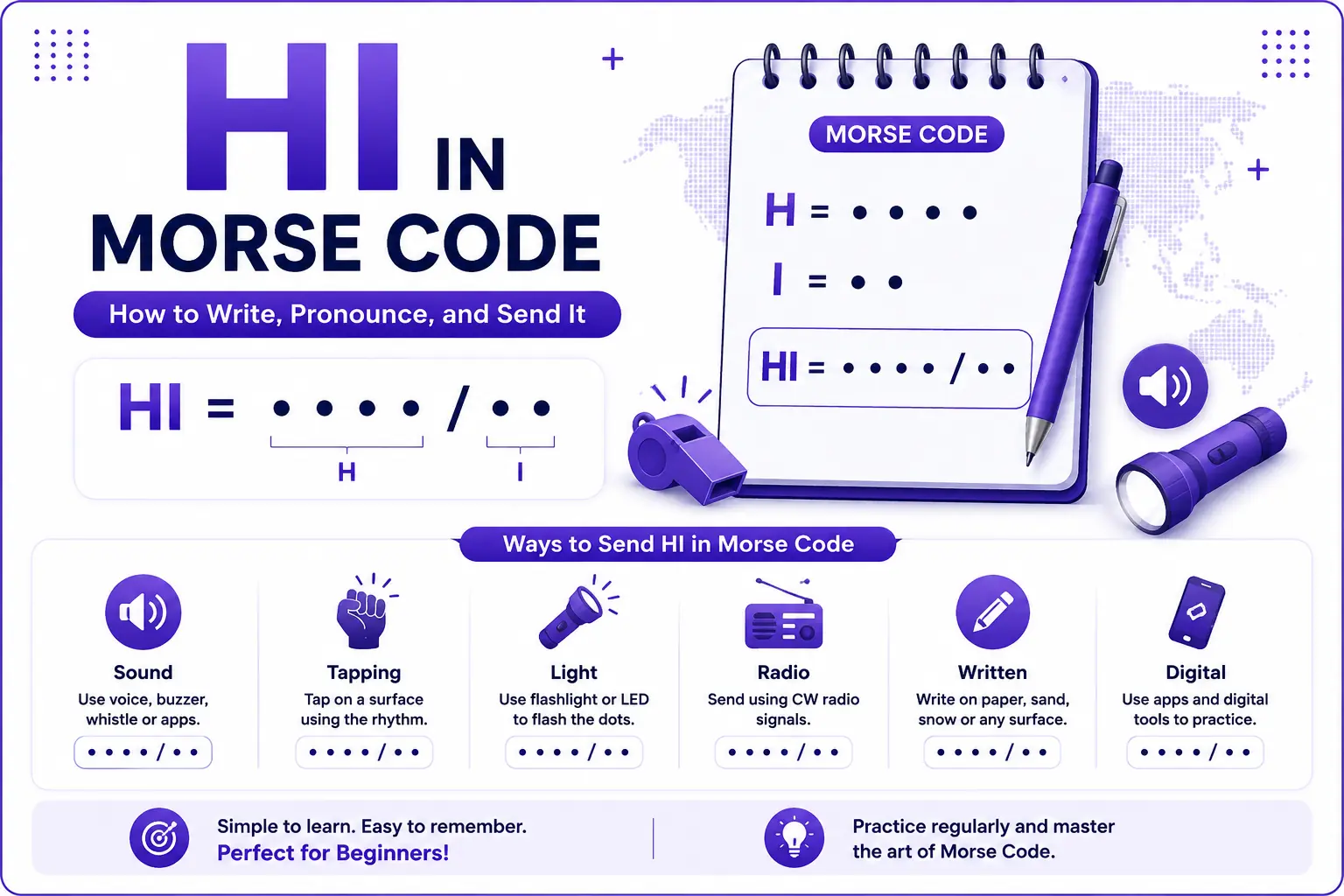
Hi in Morse code contains only dots and no dashes. H has four dots and I has two dots. The visual representation is .... .. It is one of the simplest and friendliest words in Morse code, making it a good starting point for beginners.
So, the sequence is: H = Dot Dot Dot Dot; I = Dot Dot. Leave a short letter gap between H and I.
| Character | Morse Code |
|---|---|
| H | .... |
| I | .. |
| HI | .... .. |
How to Pronounce “Hi” in Morse Code
Radio operators and Morse code learners use spoken sounds to mimic the rhythm of radio beeps. Dots are voiced as “di” or “dit,” while dashes are voiced as “dah.”
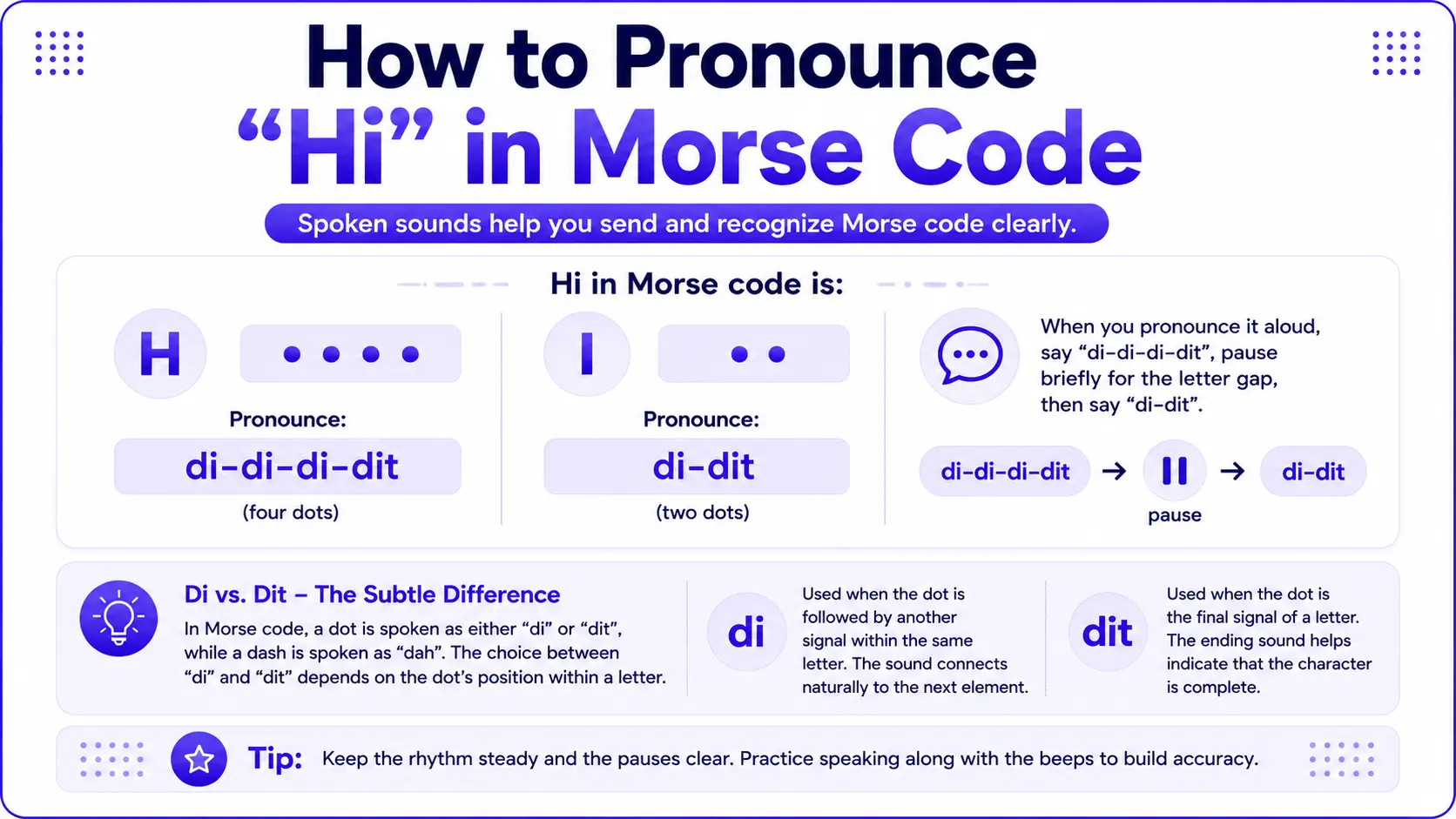
H: di-di-di-dit
I: di-dit
When you pronounce it aloud, say “di-di-di-dit,” pause briefly for the letter gap, then say “di-dit.”
Di Vs. Dit - The Subtle Difference
Amateur radio operators often learn Morse code by sound. A dot is spoken as either “di” or “dit,” while a dash is spoken as “dah.” The choice between “di” and “dit” depends on the dot’s position within a letter.
Di: Used when the dot is followed by another signal within the same letter. The sound connects naturally to the next element.
Dit: Used when the dot is the final signal of a letter. The ending sound helps indicate that the character is complete.
Example: The letter B in Morse code is -... and is vocalized as dah-di-di-dit.
How to Send “Hi” in Morse Code
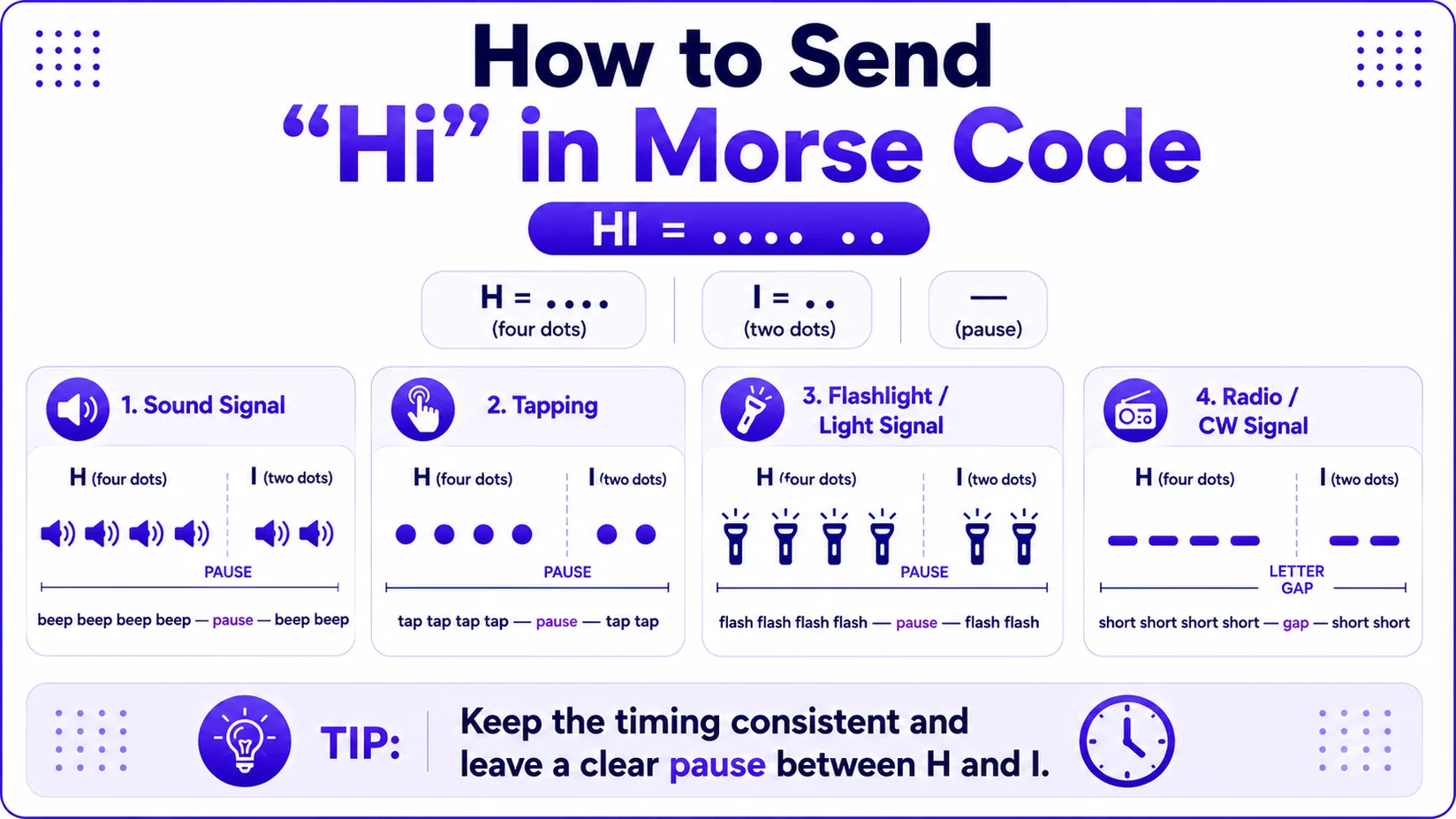
There are different ways to send Morse code using sound, tapping, light, radio, and visual signals.
Before sending a pattern, you can check it with our Morse Code Translator.
Sound
You can practice Morse code using your voice, a buzzer, whistle, or Morse practice app.
Say aloud: di-di-di-dit, pause briefly, then di-dit.
Use a short beep for each dot, and keep the pause between H and I clear. If you want to send more characters, pause briefly before moving to the next letter.
Tapping
You can tap your finger or a pen on a surface and follow the same rhythm:
- H: four quick taps
- Pause
- I: two quick taps
Tapping is a simple way to practice the rhythm of Morse code without special equipment.
Flashlight
If you’re using a flashlight, phone light, torch, LED, or another source of light:
- Use a short flash of light for each dot.
- For H (....): flash four times quickly.
- For I (..): flash twice quickly.
Keep the timing consistent and take a clear pause before starting the next letter.
Radio Waves
Amateur radio operators can transmit Morse code using continuous wave (CW) radio signals.
Send four short signals for H, pause for the letter gap, and then send two short signals for I.
Pattern: beep beep beep beep — pause — beep beep
Ham radio operators also use abbreviations and operating signals to communicate efficiently.
Written Signals
You can write .... .. on paper, sand, snow, or another surface as a visual representation of “HI” in Morse code.
Digital Signals
Morse code can also be practiced or shared with compatible smartphone apps and digital tools that produce sound, light, or written Morse patterns.
Ground Marks
You can arrange rocks, branches, or other visible objects to represent four dots for H, leave a clear gap, and then represent two dots for I. This is a visual representation rather than a timed transmission.
Morse Code “Hi” in Different Languages
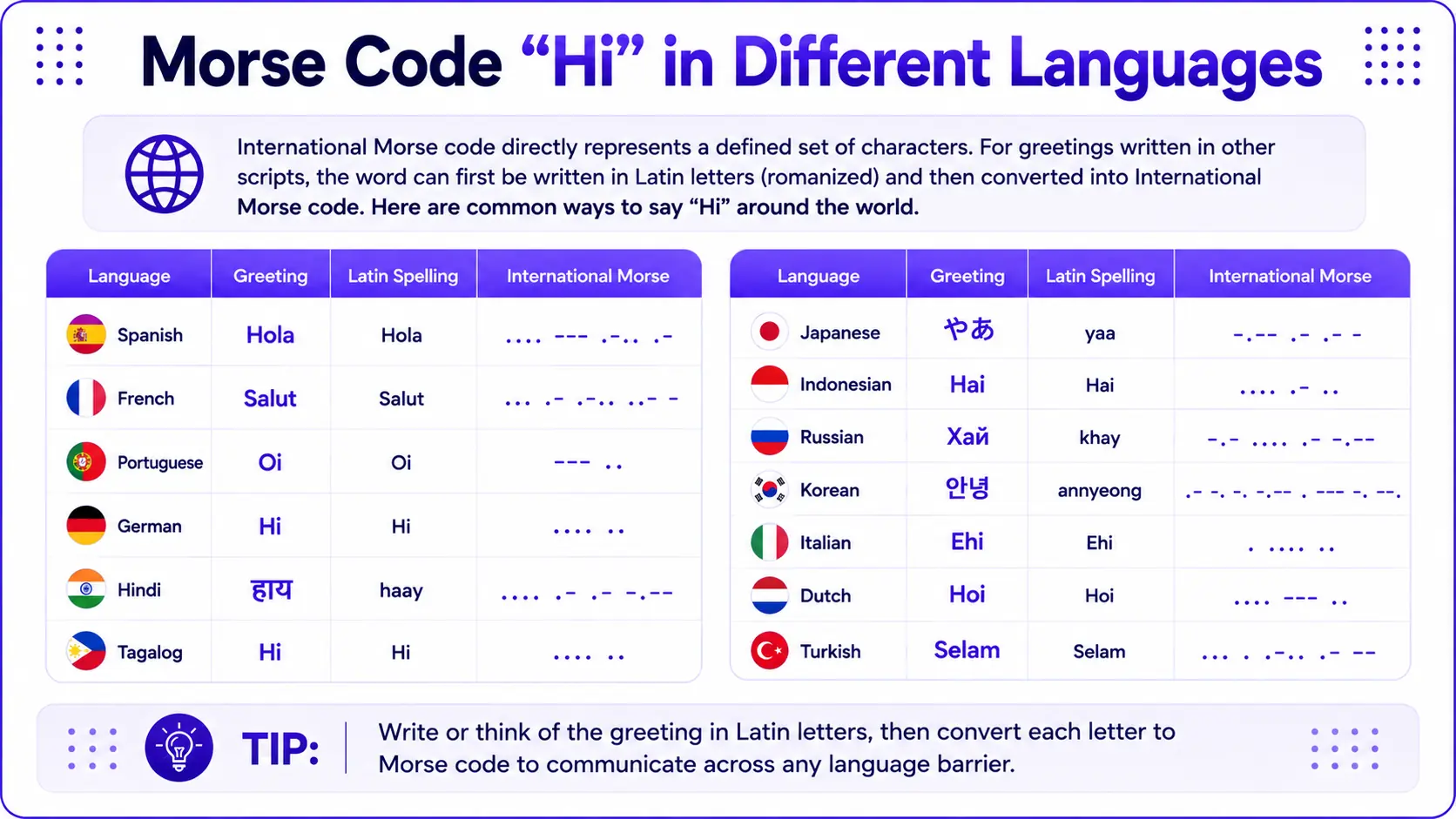
International Morse code directly represents a defined set of characters. For greetings written in other scripts, the word can first be written in Latin letters (romanized) and then converted into International Morse code. Examples:
| Language | Greeting | Latin spelling | International Morse |
|---|---|---|---|
| Spanish | Hola | Hola | .... --- .-.. .- |
| French | Salut | Salut | ... .- .-.. ..- - |
| Portuguese | Oi | Oi | --- .. |
| German | Hi | Hi | .... .. |
| Hindi | हाय | haay | .... .- .- -.-- |
| Tagalog | Hi | Hi | .... .. |
| Japanese | やあ | yaa | -.-- .- .- |
| Indonesian | Hai | Hai | .... .- .. |
| Russian | Хай | khay | -.- .... .- -.-- |
| Korean | 안녕 | annyeong | .- -. -. -.-- . --- -. --. |
| Italian | Ehi | Ehi | . .... .. |
| Dutch | Hoi | Hoi | .... --- .. |
| Turkish | Selam | Selam | ... . .-.. .- -- |
Practice Tips to Master “Hi” in Morse Code
Regular practice is important when learning Morse code. Consistent training improves your ability to recognize and send signals accurately over time. Here are some tips to improve your learning and strengthen your memory:
If you want to strengthen the H and I patterns first, review the Morse code alphabet.
- Start slowly.
- Say the pattern aloud.
- Listen to the sound.
- Spell simple words.
- Use audio practice.
- Flash or speak the pattern.
- Tap the pattern carefully and deliberately.
- Practice writing words.
- Repeat the pattern at a faster speed as you improve.
- Use flashlights or finger taps.
- Practice for 10–15 minutes daily.
Fun Fact: “Hi” in Morse Code for Beginners
HI is one of the easiest short words for beginners to practice because both H and I consist entirely of dots. You can use it for fun in classroom activities, drawings, puzzles, coded games, and hidden messages.
Secret greeting: Tap HI to greet friends with a simple coded message.
Text signature: Add .... .. to the end of a message as a quirky sign-off.
Night games: Use flashlights to send HI at night or in a dark room.
More Useful Morse Code Phrases
You can expand your Morse code vocabulary with common greetings, responses, and emergency terms while practicing timing and spacing rules:
| Phrase | Morse Code | Use Case |
|---|---|---|
| HI | .... .. | Casual greeting - beginner-friendly word |
| HELLO | .... . .-.. .-.. --- | Common greeting - a good second word to learn |
| SOS | ... --- ... | International distress signal |
| HELP | .... . .-.. .--. | Emergency word |
| OK | --- -.- | Confirmation |
| YES | -.-- . ... | Affirmative response |
| NO | -. --- | Negative response |
| LOVE | .-.. --- ...- . | Popular word for Morse jewellery and gifts |
| THANK YOU | - .... .- -. -.- / -.-- --- ..- | Polite expression - slash separates the two words |
| GOOD MORNING | --. --- --- -.. / -- --- .-. -. .. -. --. | Daily greeting |
Morse Code Etiquette in Communication
When you transmit Morse code using different types of signals, follow proper timing and spacing so your message is clear and easy to understand.
Leave proper spacing: Spacing is an essential part of Morse code. A dot lasts one time unit, a dash lasts three units, the gap between elements of the same letter is one unit, the gap between letters is three units, and the gap between words is seven units. See the International Morse Code timing rules.
End a message with AR: In CW operating, the AR prosign can be used to indicate the end of a message. It is normally sent as a prosign rather than as two separately spaced letters.
Use CQ to make a general call: In amateur radio, CQ is a general call inviting any station that is listening to respond. It is not an emergency or help signal.
Clarity is more important than speed: Focus on clarity before speed. Don’t rush the letters because poor timing can cause incorrect decoding. A slow and clear message is better than a fast and unclear one.
Stay Consistent with Rhythm: Morse code is based on rhythm and steady timing. When your rhythm stays consistent, your message becomes clearer and easier to understand.
Common Mistakes When Sending Hi
Beginners commonly make the following mistakes when transmitting HI in Morse code:
- Sending the wrong pattern
- Using the wrong spacing between H and I
- Rushing the signals
- Skipping regular practice
- Ignoring audio training