Morse code is a historic communication system developed for transmitting messages over long distances. Although one letter may seem like a small part of the system, learning individual characters helps beginners understand the complete Morse alphabet. The letter J has a memorable rhythm and a distinctive short–long–long–long structure.
This guide explains the symbol, spoken rhythm, timing rules, practical applications, and examples of J in Morse code. You can also verify the pattern with our Morse Code Translator or listen to it with the Morse audio translator.
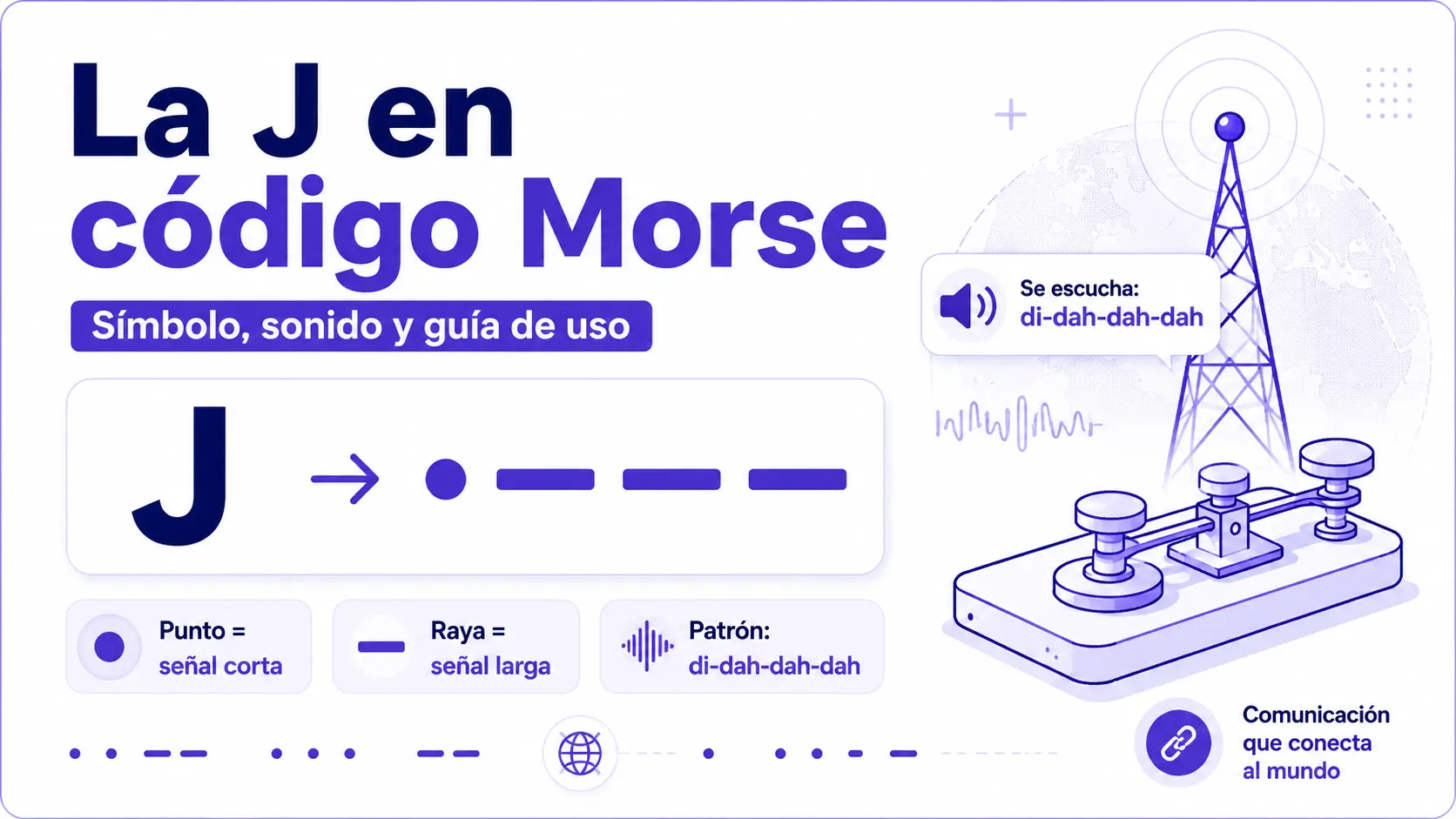
At a Glance
| Element | Value |
|---|---|
| Character | J |
| Morse Code | · − − − |
| Spoken rhythm | di-dah-dah-dah |
| NATO phonetic code word | Juliett |
| Signal elements | 4 |
| Type | Latin letter |
What Is J in Morse Code?
In International Morse code, the letter J is represented as · − − −. Its spoken rhythm is di-dah-dah-dah. It consists of one short signal, called a dit, followed by three long signals, called dahs.
From the start of the first signal to the end of the last, J takes 13 time units when its three internal gaps are included. In the NATO phonetic alphabet, the code word for J is Juliett, which helps prevent misunderstandings during voice communication.
See the complete Morse code alphabet to compare J with every other letter.
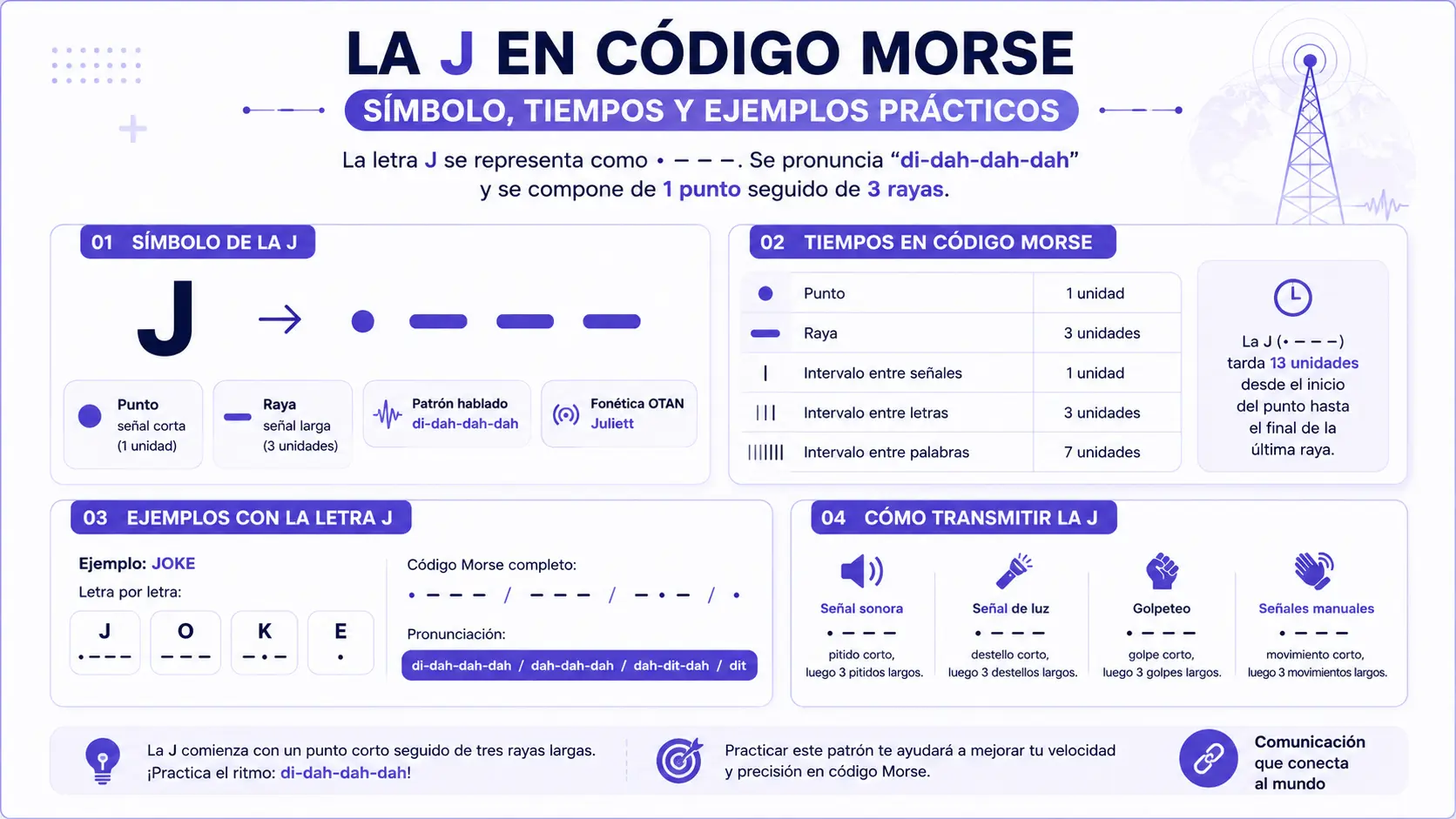
Example: JOKE in Morse Code
| Letter | Morse Code | Spoken form |
|---|---|---|
| J | · − − − | di-dah-dah-dah |
| O | − − − | dah-dah-dah |
| K | − · − | dah-dit-dah |
| E | · | dit |
JOKE: · − − − / − − − / − · − / ·
Why Does J Have a Distinctive Rhythm?
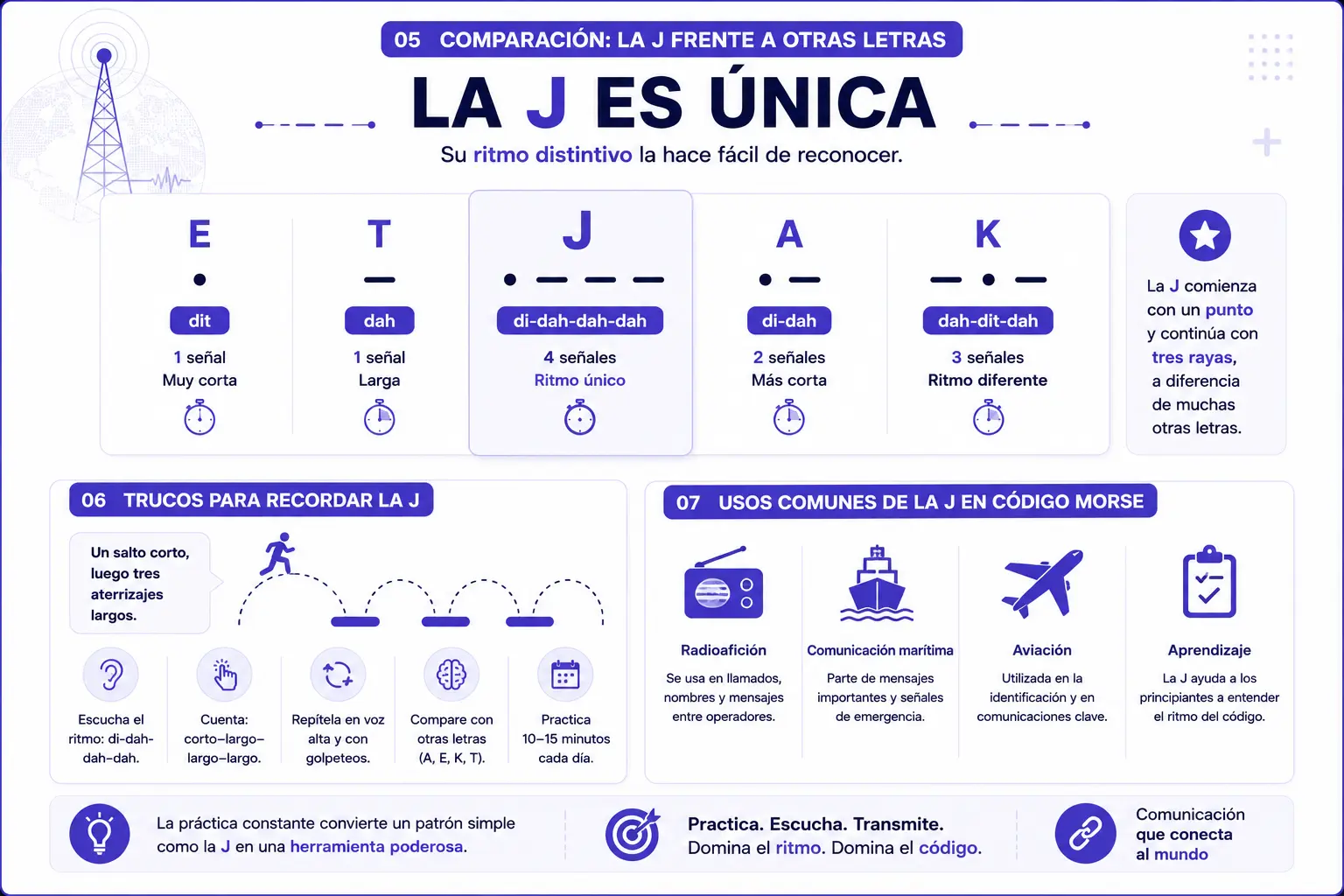
J starts with a short dot and continues with three long dashes. This contrast creates a recognizable pulse and helps distinguish it from shorter patterns such as A (· −), E (·), and I (· ·).
- One short dot.
- Three long dashes.
- Spoken rhythm: di-dah-dah-dah.
How Can Beginners Remember J?
Imagine one quick jump followed by three long landings. Repeat the rhythm short–long–long–long, listen at a slow speed, and compare J with A, E, and T. Practicing for 10–15 minutes each day helps build fast recognition.
How to Send J in Morse Code
J can be transmitted with sound, light, taps, or agreed hand movements. Keep the same sequence in every method: one short signal followed by three long signals.
Light signals
- Short flash.
- Long flash.
- Long flash.
- Long flash.
Sound signals
- Short beep (dot).
- Long beep (dash).
- Long beep (dash).
- Long beep (dash).
Tapping signals
Make one short tap followed by three longer taps on a table or another surface. Keep a one-unit pause between signals inside the same letter.
Hand signals
For informal practice, agree on one short movement for the dot and three longer movements for the dashes.
Morse Code Timing for J
The dot is the basic time unit. A dash lasts three units, the gap between elements inside a letter lasts one unit, the gap between letters lasts three units, and the gap between words lasts seven units.
| Element | Duration |
|---|---|
| Dot | 1 unit |
| Dash | 3 units |
| Gap within a letter | 1 unit |
| Gap between letters | 3 units |
| Gap between words | 7 units |
For J, the calculation is 1 unit for the dot + 9 units for the three dashes + 3 units for the internal gaps = 13 units.
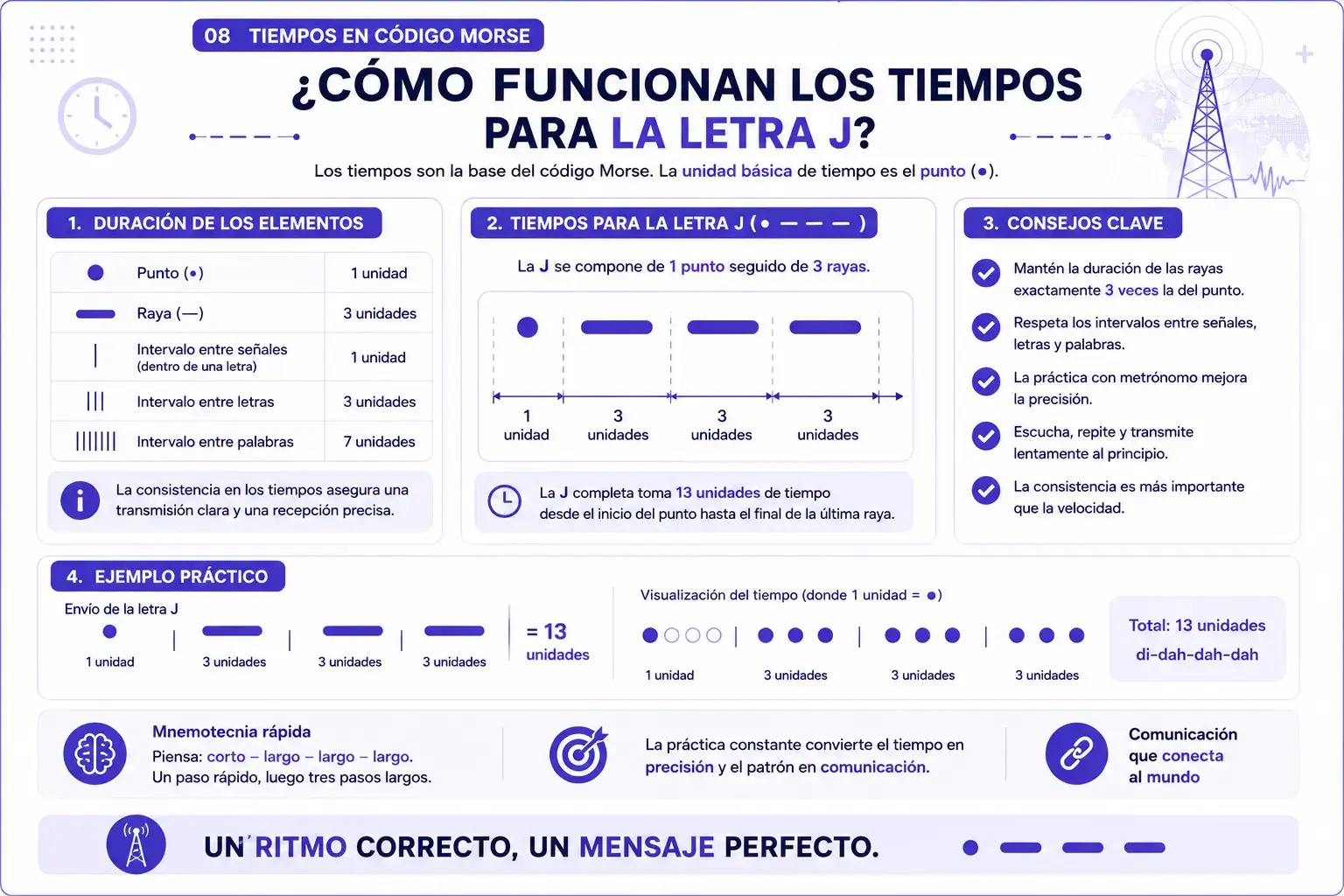
These rules are part of International Morse code and help receivers decode messages accurately.
Where Is J Used in Morse Code?
| Field | Use |
|---|---|
| Amateur radio | J can appear in names, messages, and call signs transmitted in Morse code. |
| Maritime communication | Signal lamps have historically been used for identification, warnings, and short messages. |
| Emergency signaling | J may form part of a name, location, or other message sent with light, sound, or taps. |
| Historical military communication | Morse code was used to transmit standardized messages over distance. |
Historical importance and modern technology
Telegraph and radio operators historically used letters such as J in civilian, maritime, and military messages. Today, Morse code remains present in amateur radio, some navigation aids, educational tools, puzzles, and popular culture.
Names and call signs
J appears in names such as Justin, Jane, and Janet, and in illustrative sequences such as JA1XYZ. In radiotelephony, its NATO code word is Juliett; in Morse code, it is sent as · − − −.
Build your skills step by step with the guide to learning Morse code.
Using J in Coded Notes and Games
The J pattern can be used in notes, puzzles, drawings, or coded games. Morse code is an encoding system, however, and does not provide secure encryption.
J: · − − −
JOY: · − − − / − − − / − · − −
Common Words Beginning with J
| Word | Morse Code |
|---|---|
| JAM | · − − − / · − / − − |
| JAR | · − − − / · − / · − · |
| JOB | · − − − / − − − / − · · · |
| JET | · − − − / · / − |
| JUMP | · − − − / · · − / − − / · − − · |
| JUST | · − − − / · · − / · · · / − |
| JACK | · − − − / · − / − · − · / − · − |
Practice Tips for Learning J
- Say the rhythm aloud: di-dah-dah-dah.
- Listen to the sequence at different speeds.
- Spell simple words that contain J.
- Practice with a flashlight or finger taps.
- Use short practice sessions every day.
Frequently Asked Questions
Related Morse Code Guides
Final Thoughts
J has a distinctive short–long–long–long pattern. With regular practice, it becomes easy to recognize and transmit accurately. Mastering J also provides a useful foundation for understanding the rest of the Morse alphabet.