Table of Contents
- How Morse Code Changed Human Communication
- What Is Morse Code?
- Communication Before Morse Code
- Who Invented Morse Code?
- The Creation of Morse Code in the 1830s
- The First Morse Code Message in History (1844)
- The Evolution of Morse Code
- The Global Expansion of Morse Code
- Morse Code During Wars and Emergencies
- The Titanic and the Role of Morse Code in Maritime History
- Morse Code History Timeline
- Why Morse Code Is Important in Communication History
- FAQs About the History of Morse Code
How Morse Code Changed Human Communication
Morse Code is one of the most significant communication systems ever created. It transformed written messages into a simple pattern of dots and dashes. Now, people can send information across long distances almost instantly.
Before Morse Code, the only source of communication was physical messengers, ships, and slower signaling methods. So, there was a need for a quick system that could convert letters, words, and Morse code numbers into electrical signals.
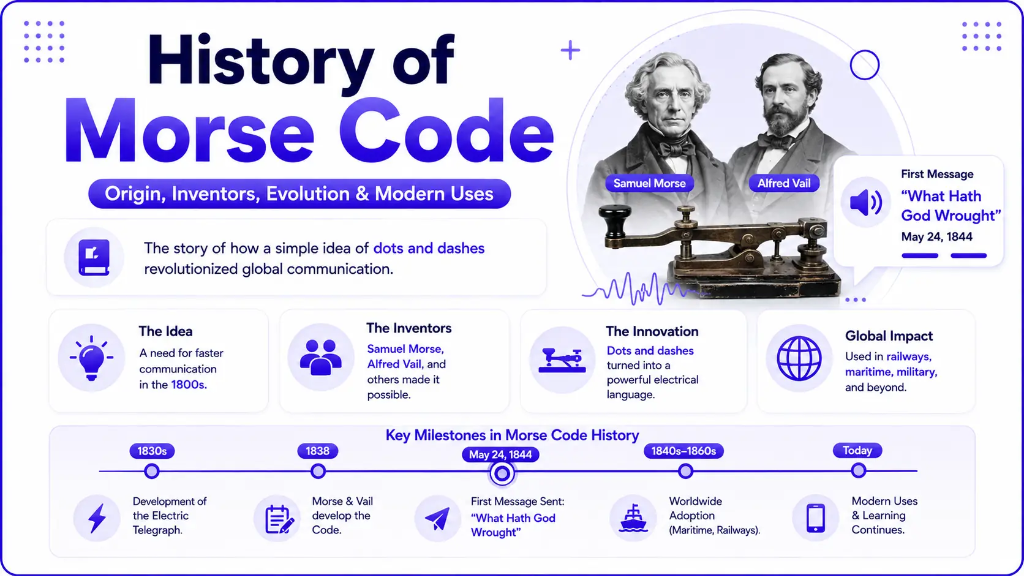
The Morse Code was developed by Samuel Morse. Later, Alfred Vail further improved the code and made it practical for everyday use. In 1844, the first message, «What hath God wrought?», was sent from Washington, D.C., to Baltimore, proving that messages could travel faster than ever before.
What Is Morse Code?
Morse Code is a communication system that represents letters, numbers, and symbols using combinations of short signals (dots) and long signals (dashes).
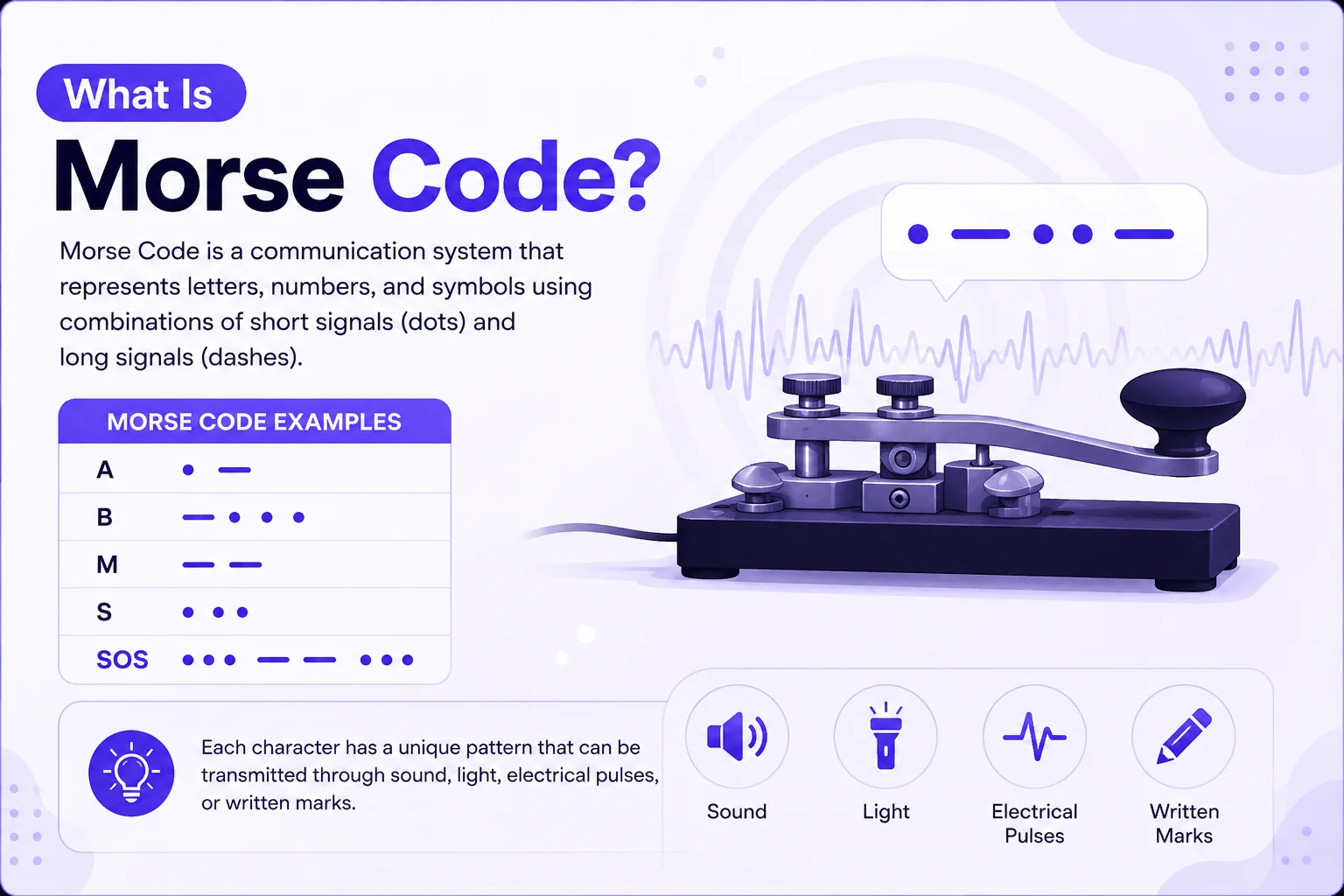
For example, across the Morse code alphabet we have:
- Letter A = .- (dot-dash)
- Letter B = -... (dash-dot-dot-dot)
- Letter M = -- (dash-dash)
- Letter S = ... (dot-dot-dot)
- SOS Signal = ... --- ...
Each character has a unique pattern that can be transmitted through sound, light, electrical pulses, or written marks. You can translate any text instantly using our free online Morse code translator.
Communication Before Morse Code
Early Methods of Long-Distance Communication
Before learning the history of Morse Code, it’s important to understand the communication challenges people faced before this invention.
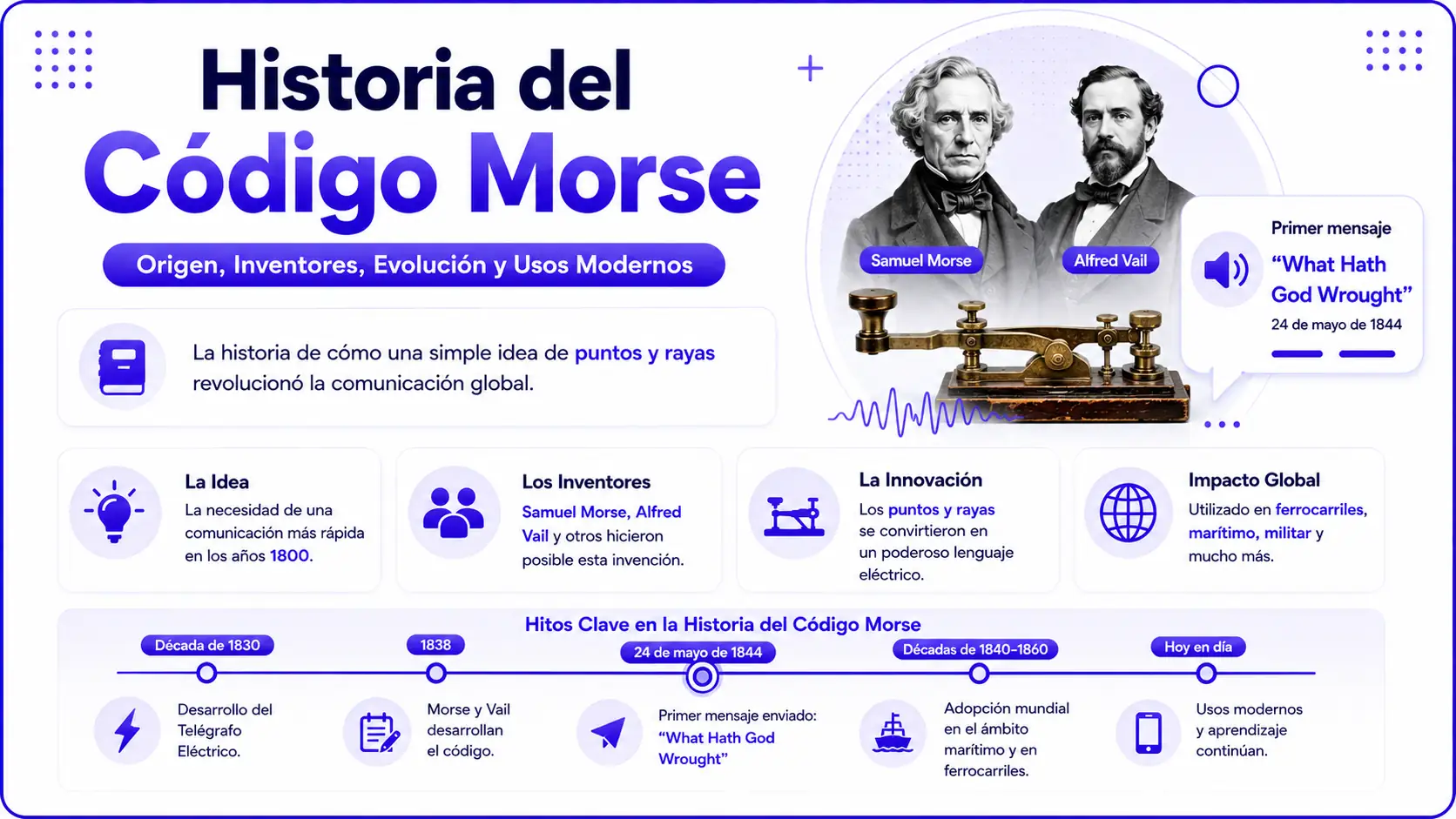
In the early 1800s, people commonly used:
- Messengers and written letters: Messages had to be carried by people, horses, stagecoaches, or ships, which could take days, weeks, or even months across oceans.
- Visual signaling systems: Methods like beacon fires, flags, heliographs, and optical semaphore telegraphs allowed faster communication between hilltops, but critical weather conditions (fog, night, storms) frequently disturbed them.
Historical Context: In 1825, Samuel Morse was working as a painter in Washington, D.C., when his wife Lucretia fell ill and died in New Haven, Connecticut. By the time a horseback messenger delivered the letter, she had already been buried. This personal tragedy sparked Morse’s lifelong passion to create instantaneous long-distance communication.
Why the World Needed Faster Communication
As industries expanded during the Industrial Revolution, the need for faster communication methods enhanced:
- Commerce: Businesses wanted quicker information exchange and market updates.
- Railways: Railway companies needed safer coordination on single-track lines to avoid collisions.
- Governments: Governments required more reliable ways to share messages across vast territories.
Then the invention of the electric telegraph created the foundation for Morse Code. Morse Code made it possible to send, receive, and decode messages quickly over long distances.
Who Invented Morse Code?
The creation of this communication system was a combined effort involving several inventors, engineers, and scientists who helped turn an idea into a practical technology.
The main contributors were:
Samuel Morse: The Creator Behind the Name
Samuel Morse developed the telegraph system and helped create a method for transmitting messages through electrical signals. The challenge was not only sending electrical signals over wires but also creating a simple method to represent letters and numbers. The solution was a code made from short and long signals, later known as dots and dashes.
Alfred Vail: The Engineer Who Improved Morse Code
Alfred Vail improved the telegraph machine and helped develop the practical dot-and-dash alphabet system that made Morse Code easier to use. Vail researched the frequency of letters in local printing offices to assign the shortest codes to the most frequent letters (such as a single dot for E and a single dash for T). This allowed operators to send and decode messages faster, which helped Morse Code become useful for real-world communication.
Leonard Gale’s Technical Contribution
Leonard Gale further improved the telegraph system and resolved the early signal problems by applying Joseph Henry’s high-intensity electromagnetic circuits, allowing currents to travel over long wire distances without dissipating.
The Creation of Morse Code in the 1830s
Development of the Electric Telegraph
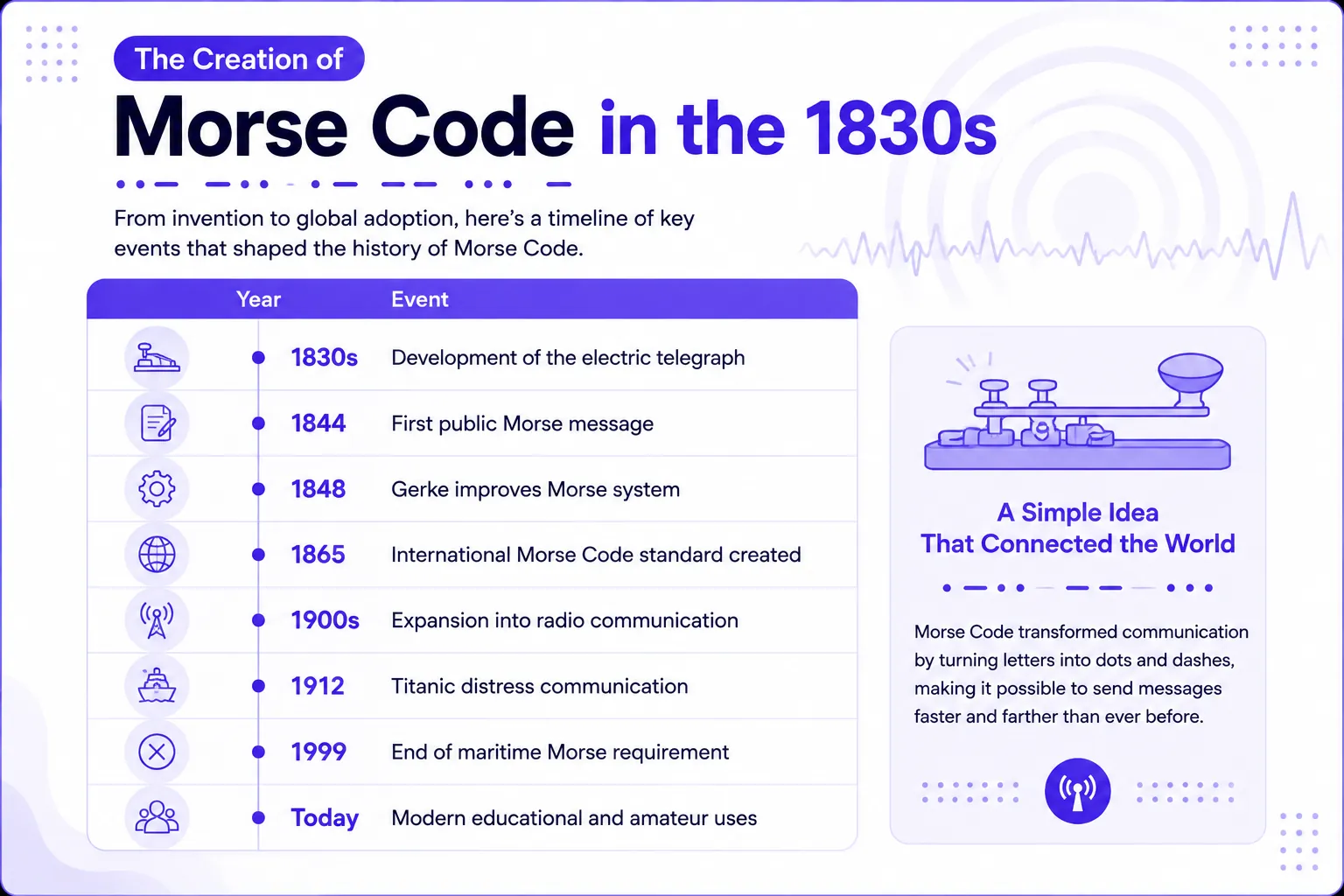
During the 1830s, several inventors experimented with electrical communication systems. The goal was to create a device that could send signals over wires and reproduce messages at a distant location. Samuel Morse and his team developed an electromagnetic telegraph that worked by sending electrical pulses through a single wire circuit.
How the Dot and Dash System Was Created
To make the telegraph practical, Morse and his collaborators created a unique combination of signals. The basic idea was simple:
- Short signals represented dots (·)
- Long signals represented dashes (−)
- Different combinations created different letters and numbers
For example:
- A = .-
- B = -...
- M = --
- S = ...
This simple design made sending and decoding quick without needing any complex mechanical printing equipment.
The First Morse Code Message in History (1844)
Samuel Morse sent the first official public message, «What Hath God Wrought,» on May 24, 1844. This was a major turning point in telecommunications history.
«What hath God wrought?»
(Book of Numbers 23:23 — Transmitted from the Old Supreme Court Chamber in the U.S. Capitol to Baltimore)
The message was transmitted from Washington, D.C., to the Mount Clare Station in Baltimore, Maryland. It proved to the world that electrical communication could send complex human language over long distances with complete accuracy in fractions of a second.
The Evolution of Morse Code
American Morse Code vs International Morse Code
The early version of Morse Code was called American Morse Code (or Railroad Morse). It was designed for land-based telegraph lines in North America. However, as the telegraph network expanded internationally, the original system had some limitations: it contained dashes of varying lengths and internal spaced elements within letters (like the letter C or letter O).
The Development of International Morse Code
In 1848, German telegraph operator Friedrich Clemens Gerke created an improved version of Morse Code in Hamburg. Gerke standardized the timing so that all dashes are exactly three times the duration of a dot:
- Dots (short signals = 1 unit)
- Dashes (long signals = 3 units)
Gerke also adjusted character patterns like the letter J, letter K, and letter L to make the code easier to transmit, understand, and use across different languages. In 1865, the International Telegraph Conference in Paris adopted Gerke’s revised system as the universal standard: International Morse Code.
The Global Expansion of Morse Code
After the successful introduction of the telegraph, Morse Code quickly moved beyond local communication networks and became a worldwide messaging system.
Morse Code in Railways
The railway industry was the first user of Morse Code. As railway networks expanded, companies needed a faster way to coordinate train schedules, share updates, and improve safety. Morse Code helped railway operators:
- Send instant operational messages
- Improve railway safety on single-track lines
- Connect distant locations and dispatchers
Morse Code in Shipping and Maritime Communication
Morse Code became very significant at sea because ships needed a reliable way to communicate when they were far away from land. Maritime operators used Morse Code for:
- Ship-to-ship communication
- Messages between ships and coastal stations
- Weather information and hazard warnings
- Emergency distress and help signals
Morse Code in Radio Communication
After the invention of radio technology in the 1890s by Guglielmo Marconi, Morse Code found a new purpose. Before voice transmission became practical, radio operators used Morse Code to send messages through wireless signals (Continuous Wave / CW). Radio Morse Code became important for military communication, aviation beacons, and amateur radio.
Morse Code During Wars and Emergencies
During the 20th century, Morse Code became a necessity of military communication and emergency signaling. This was the primary system that made it possible to transmit messages during situations where speed, reliability, and secrecy were important.
Morse Code in Military Communication
The military used Morse Code because it provided a reliable way to exchange information during conflicts. It was used for:
- Sending strategic and tactical messages
- Long-distance communication over weak signals
- Secure battlefield messaging and encrypted traffic
Morse Code During World War I and World War II
During World War I and World War II, Morse Code played a key role in military radio communication. Operators were trained to send and decode messages at high speeds under difficult battlefield conditions.
SOS Emergency Signal
SOS in Morse Code is the most recognized international distress signal, represented by:
... --- ...
Three short signals (S) · Three long signals (O) · Three short signals (S)
SOS became popular because it is simple and easy to recognize, and could be transmitted through radio, lights, or sound signals.
Why Morse Code Remained Important During Emergencies
Morse Code continued to be valuable because it could work in situations where modern communication systems might fail. Its advantages included:
- Low equipment requirements and low power consumption
- Ability to work over long distances and cut through heavy static
- Easy transmission through sound, light, or mechanical taps
- Unmatched reliability in severe emergency conditions
Even in this modern world, amateur radio operators, emergency communication groups, and people interested in historical communication methods continue to learn Morse code.
The Titanic and the Role of Morse Code in Maritime History
The Titanic disaster of 1912 became one of the most famous examples of how Morse Code was used during a life-threatening emergency. When the RMS Titanic struck an iceberg on April 14–15, 1912, its wireless operators used Morse Code through a Marconi radio telegraph system to send distress messages and request help from nearby ships.
Morse Code Distress Messages During the Titanic Disaster
The Titanic’s wireless operators, Jack Phillips and Harold Bride, transmitted emergency signals from the ship’s Marconi radio room as the vessel began sinking. At that time, operators commonly used the British distress signal CQD, while the newer international SOS signal was also transmitted during the emergency.
The distress calls were received by the nearby steamship RMS Carpathia, which immediately turned around and raced to the rescue, saving 705 lives from the lifeboats.
The story of the Titanic and Morse Code shows how a simple system of dots and dashes became a critical tool for saving lives at sea. Although technology has changed, the event remains one of the most recognized examples of Morse Code’s importance in communication history.
Morse Code History Timeline
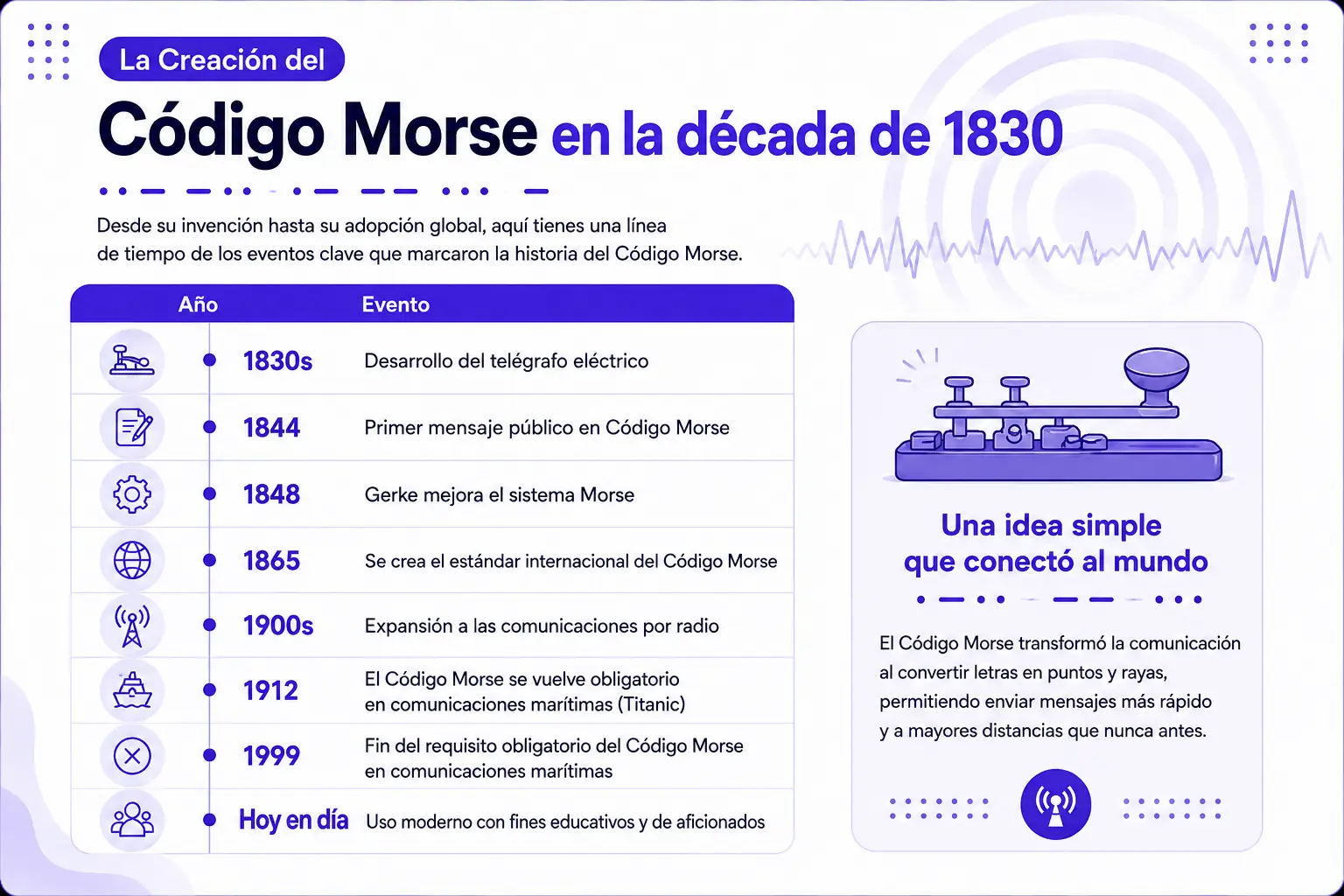
The timeline below highlights the major milestones that shaped Morse Code from its 19th-century invention to its present-day roles:
| Year / Era | Event |
|---|---|
| 1830s | Development of the electromagnetic telegraph and initial dot-and-dash code by Samuel Morse, Alfred Vail, and Leonard Gale. |
| 1844 | First official public Morse message («What hath God wrought?») sent between Washington, D.C., and Baltimore. |
| 1848 | Friedrich Clemens Gerke improves the Morse system in Hamburg, standardizing dot/dash lengths and removing internal spaces. |
| 1865 | International Telegraph Conference in Paris establishes International Morse Code as the global standard. |
| 1900s | Expansion into wireless radio communication (Continuous Wave CW) for maritime fleets and military forces. |
| 1912 | Titanic distress communication demonstrates the critical importance of Morse code and 24-hour radio watches. |
| 1999 | Official end of the mandatory maritime Morse requirement, replaced by digital satellite GMDSS systems. |
| Today | Modern educational, cryptographic, aviation navigational aid (VOR/NDB), and amateur radio (ham radio CW) uses. |
Why Morse Code Is Important in Communication History
Morse Code is important because it changed the way humans shared information across long distances. Before its invention, messages could take days or weeks to arrive. Morse Code made it faster by converting language into simple electrical signals that could travel through telegraph networks.
Morse Code connected cities, governments, businesses, railways, and ships because of its instant long-distance messaging system. Its impact included:
- Faster information exchange: Near-instantaneous transmission across vast territories.
- Growth of international communication: Paved the way for transatlantic undersea cables and global networking.
- Foundation for future technologies: The binary on/off concept directly inspired early computing and digital data transmission.
You can explore more tools like our Morse code audio translator and Morse code image translator to hear and see how Morse code works today.